

October 19, 2026 – George Soros will be remembered as not only one of the market’s greatest global macro investors, but also one of its greatest philosophers. In addition to generating the 32% annualized return of his Quantum Fund between 1969 and 2000, he’ll be remembered for writing 14 books, from 1987’s The Alchemy of Finance through 2019’s In Defense of Open Society.
While he became famous for shorting the British pound in 1992 and making an approximate $1 billion profit (from a short sterling position of roughly $10 billion), Soros stands out intellectually for his theory of reflexivity.
Reflexivity is the idea that people’s perceptions of reality can influence reality itself, creating self-reinforcing feedback loops between beliefs and fundamentals. From a stock market perspective, this means that not only do fundamentals affect a stock’s price, but a stock’s price affects its underlying fundamentals.
The theory of reflexivity challenges the status quo in markets. The conventional assumption is that asset prices merely reflect underlying economic fundamentals. Soros’ theory argues that market prices can themselves influence fundamentals through self-reinforcing cycles.
Soros identified two key interconnected functions. First, the cognitive function describes how market participants attempt to understand economic circumstances and form expectations about the future. Second, the participatory function details how participants act on those expectations, influencing the economic reality that they are observing through the capital markets.
For example, investors may believe a company’s growth prospects are improving and therefore bid up its stock price, in turn reducing the firm’s cost of capital and allowing it to raise money to fund growth initiatives. In this scenario, investor optimism can help the original forecast come true. The positive feedback loop in which a higher stock valuation leads to cheaper and more accessible financing, which generates more investment in capacity and growth, results in stronger growth expectations and higher investor bullishness.
A high equity valuation, and the resulting lower cost of capital, effectively becomes a competitive advantage. In extreme cases, some firms’ business models implicitly depend on maintaining elevated valuations (see crypto treasury companies as a recent example).
However, reflexivity can work to the downside as well, particularly for capital-intensive, unprofitable businesses that rely heavily on access to capital.
For profitable, capital-light businesses, a falling share price or rising credit spread may have little operational impact (in fact, it may allow them to capitalize by repurchasing their shares at lower prices, which is accretive, in theory). However, for capital-intensive businesses that continuously require external financing, falling share or bond prices can become an existential threat.
When investor sentiment changes, which can happen seemingly on a dime, the reflexive cycle can reverse violently. A declining share price and rising credit spread can hit investor confidence. A lower equity valuation can lead to higher dilution. Meanwhile, surging bond yields make debt financing increasingly expensive or even unavailable. Once access to capital slows, capital expenditures are delayed, projects are abandoned, and growth expectations are reduced. All the while, the company’s liabilities and capital commitments remain intact. Accordingly, cash burn persists while financing options shrink, leading to financial distress or even bankruptcy.
In this scenario, a company does not suffer simply because investors correctly anticipate financial distress (although short sellers are generally known for this, however, they are a very small minority these days). A company enters financial distress simply because investors withdraw their financing and the company loses access to capital.
A key insight of reflexivity is that a company’s access to capital is not independent of its valuation and, under certain circumstances, can be a primary driver of it. In fact, the two are interconnected, creating powerful positive and negative feedback loops. A company that could have been viable with continued access to capital may be dead without it.
This phenomenon played out through the dot-com bubble and bust. The late ’90s stock market boom with rising investor confidence provided cheap equity and debt capital to many burgeoning new companies. However, when the cycle turned from boom to bust, the capital access spigot was turned off, and many companies that could not reach profitability went under. Many of these new business models were not inherently bad, they just caught the wrong end of reflexivity. Notorious busts from that cycle, including Pets.com and Webvan, were effectively reincarnated later as successful businesses. Pets.com’s concept was successfully realized by Chewy.com decades later, while Instacart became the successful version of Webvan. There are many such cases.
In the current market environment, no new business model may better highlight the opportunities and dangers of reflexivity than the neocloud.
A neocloud is a specialized cloud computing company that rents out compute primarily to artificial (err, super) intelligence companies. Neoclouds rent access to AI chips (primarily GPUs) that AI companies use to train and run their models. At a high level, their business model involves raising capital, buying Nvidia GPUs, installing them in data centers, and renting out the computing power at a (hopefully) higher price than their costs. These costs include electricity, operating expenses, depreciation, and most importantly, interest expenses.
A large contingent of neoclouds have bitcoin and crypto mining roots, which makes sense, given both business models involve running buildings full of powerful, specialized chips. Several years ago, when crypto swooned and AI boomed, many crypto companies pivoted to AI. As a result, neoclouds have become one of the more competitive and commoditized segments of the AI value chain, while exposing investors to significant risks.
Nevertheless, investors were more than keen to support this pivot, providing tens of billions of dollars of debt and equity capital to neoclouds at increasingly lofty valuations. The thesis was that as demand for AI grows, the need for compute (and neocloud-provided GPU capacity) will increase, boosting neocloud revenue and encouraging even more investment. However, this virtuous cycle has limits, and a vicious cycle can start once access to capital disappears (which can happen for a myriad of reasons).
Companies such as CoreWeave, Nebius, and IREN are building extremely capital-intensive businesses around demand for AI compute. These neoclouds have raised enormous amounts of capital to buy GPUs, expand capacity, and grow. As a result, neoclouds generally have significant spending requirements, along with enormous levels of debt, that make them increasingly reliant on the capital markets.
This dynamic has come to a head this month as neocloud share and bond prices have come under pressure amid declining investor enthusiasm. Whether the decline stems from worries about potential AI overcapacity, a forecast decline in GPU rental rates, or the sustainability of hyperscaler spending, neoclouds have borne the brunt of it.
The largest neocloud, CoreWeave, offers a good case study on how access to capital can become just as important as customer demand for a capital-intensive, rapidly growing AI business. This month, its stock has declined by -31%. More importantly, the price of its bonds have declined to the low 80s, implying a yield of nearly 15%. Its bonds trading at a distressed level do not bode well for the eventual refinancing of its $36 billion of current debt, nor the funding of the tens of billions of dollars of future spending commitments. A double-digit junk bond yield implies that access to debt capital has been cut. Moreover, while it does have an at-the-market equity issuance program, along with a $34 billion market cap, a rapid increase in stock issuance into a declining market rarely plays out well for companies and their shareholders, but it may buy some time.
Nevertheless, the next few months will show how succinctly the effect of declining share prices, widening credit spreads, and a potential closing of the capital markets has on the fundamentals of the neoclouds.
Some investors may push back at this thesis, arguing that the recent weakness in the neoclouds’ security prices is irrational, given that underlying GPU rental prices are robust and the AI and hyperscaler clients are doing well. Be that as it may, this opposition supports the theory of reflexivity, in which the mere decline in a company’s stock and bond price (irrespective of the cause, if any) negatively affects its fundamentals, paradoxically driving its market price even lower.
That said, it is undeniable that a recent shift in investor sentiment has begun to result in a real deterioration in these businesses’ underlying growth prospects, which in turn negatively affects their stock (and bond) market valuation, creating a negative feedback loop.
This dynamic does not prove that a neocloud bust is inevitable, but it demonstrates just how sensitive this business model can be to confidence in future financing, and how quickly that outlook can change.
On a recent podcast, venture capitalist Ben Horowitz described the danger of this situation:
“If you get into a pathological debt situation, that can wreck anybody. It’s why, by the way, we’re not invested in any of these neoclouds, for that reason. That whole thing scares me, having been through it. It can end up being a very dangerous arbitrage business where you can get upside down easily.”
While reflexivity can enable rapid growth and wealth creation on the way up, it can become a trap, leading to a rapid unwind and financial distress of the participating businesses on the way down. For certain AI companies (in particular the neoclouds) that are dependent on continuous external financing, access to capital is not merely a source of funding, but a fundamental component of their enterprise value and their ultimate viability as a going concern. When the capital window shuts, a company can transition from a promising growth story to financial distress at remarkable speed.
The ultimate paradox of Soros’ theory of reflexivity is that a company can fail not because its underlying fundamentals were flawed, but because investors collectively decided to stop funding it. That’s the reflexivity trap.
The AI value chain presents a myriad of opportunities for investors, both long and short. To help facilitate idea generation, we highlight one top-decile stock that is forecasted to outperform and one bottom-decile stock that is predicted to underperform based on Accelerate’s multi-factor composite model in this month’s AlphaRank Top Stocks.
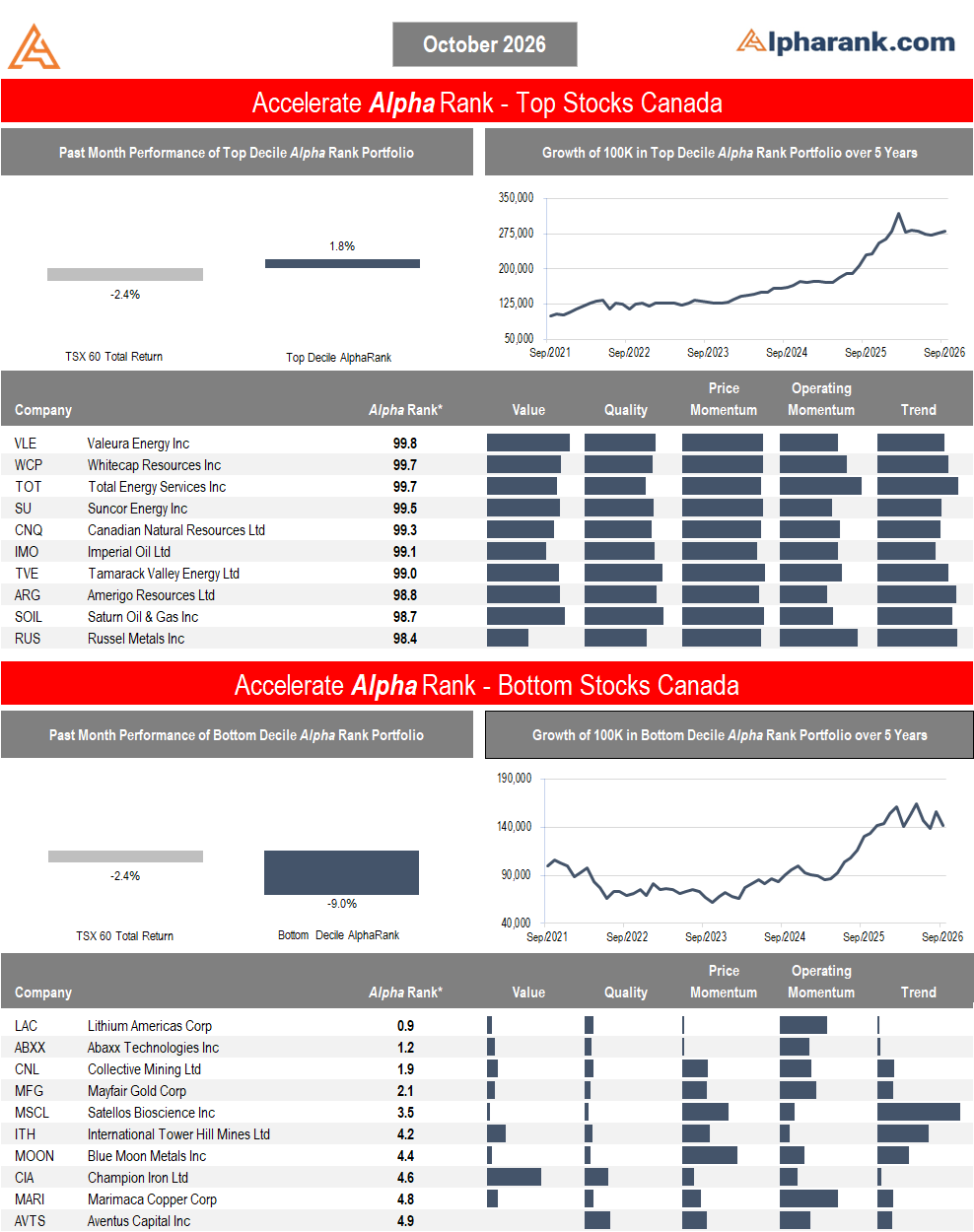
OUTPERFORM: Russel Metals Inc. (TSX: RUS) is one of North America’s largest metals distribution and processing companies. It purchases steel and other metals from producers, maintains inventories, performs value-added processing, and distributes materials to industrial customers.. The bull case for the stock centers around consolidation in the fragmented metals distribution industry, improving profit margins, disciplined capital allocation, and increased exposure to U.S. industrial activity (including the data center build out). RUS has a mid-teens return on capital and has been using its free cash flow to repurchase its shares. Moreover, its below-market valuation appears attractive in the context of a recent significant earnings beat and rising earnings estimates. With positive share price momentum, along with an AlphaRank score of 98.4/100, we expect RUS shares to continue to outperform. Disclosure: Long RUS in the Accelerate Canadian Long Short Equity Fund (TSX: ATSX).
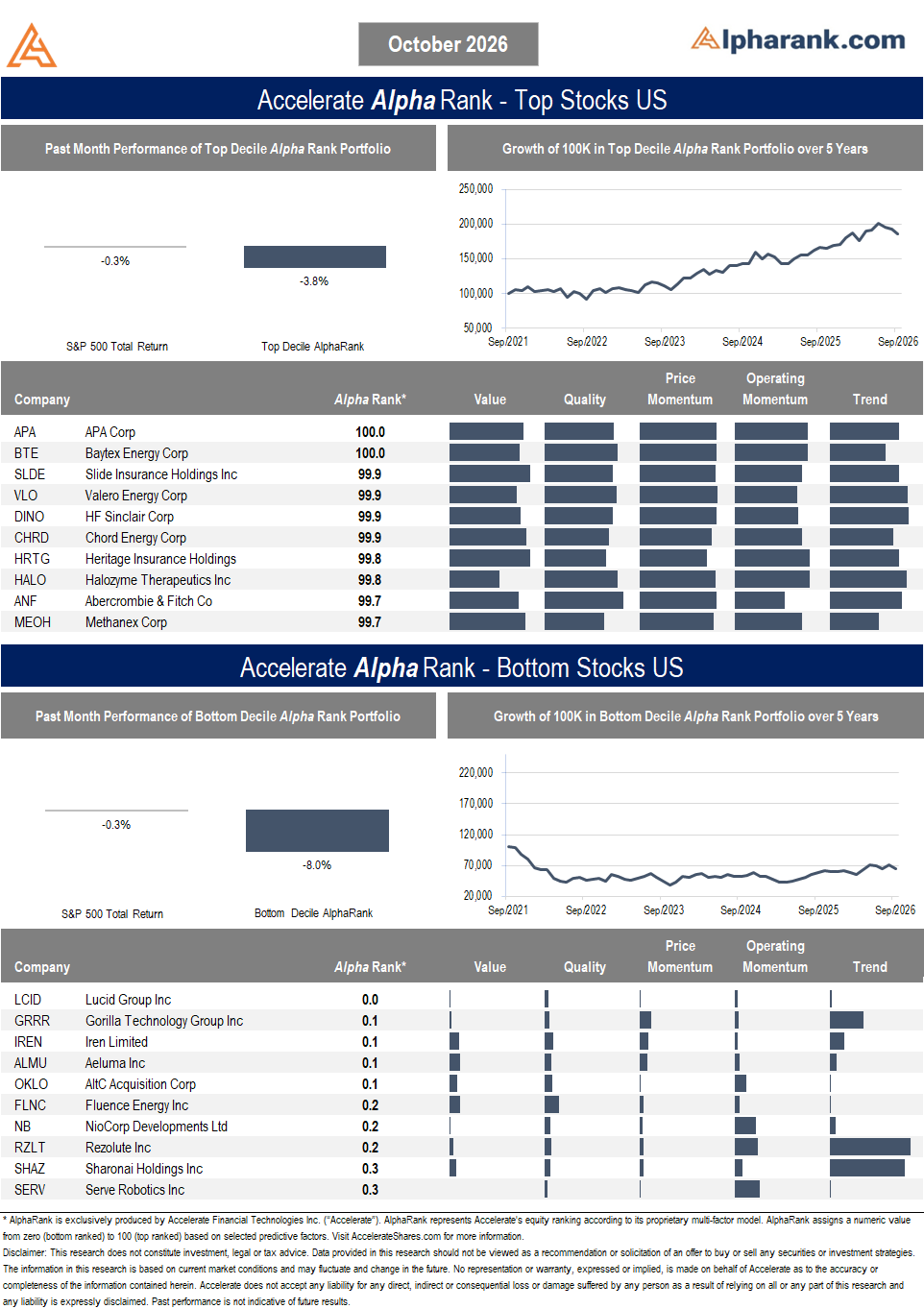
UNDERPERFORM: IREN Ltd (NASDAQ: IREN) historically operated Bitcoin mining facilities, however, it is now transforming itself into a vertically integrated AI infrastructure provider and neocloud. Similar to CoreWeave, IREN requires billions of dollars of capital before much of its expected revenue is generated. The company raised approximately $9.7 billion through financing activities on a net basis during FY2026, while its capital commitments at year-end reached almost $14 billion. It is reliant on continuous debt and equity capital raises to fund this growth, which not only exposes investors to significant risk but is also dilutive to shareholders. IREN is exposed to a reflexive financing cycle, which is currently experiencing a negative feedback loop. With negative share price momentum and an AlphaRank score of 0.1/100, we expect IREN shares to continue to underperform. Disclosure: No position in IREN, short CRWV in the Accelerate Absolute Return Fund (TSX: HDGE).
The AlphaRank Top and Bottom stock portfolios exhibited positive relative performance last month:
- In Canada, the top-ranked AlphaRank portfolio of stocks increased by 1.8%, outperforming the benchmark’s -2.4% loss, while the bottom-ranked portfolio of Canadian equities plunged by -9.0%. The long-short portfolio (top minus bottom-ranked stocks) gained 10.8%, as the top-ranked stocks materially outperformed the bottom-ranked securities. Over the past five years, the top decile AlphaRank portfolio has gained 181%, while the bottom-ranked portfolio has risen by 42%.
- In the U.S., the top-decile-ranked equities fell by -3.8%, underperforming the S&P 500’s -0.3% drop. Meanwhile, the bottom-ranked stocks fell by -8.0%, resulting in a 4.2% gain for the top decile minus the bottom decile long-short portfolio. Over the past five years, the top-ranked U.S. equities have gained 86%, while the bottom-ranked portfolio has declined by -35%.
AlphaRank Top Stocks represents Accelerate’s predictive equity ranking powered by proven drivers of return. Stocks with the highest AlphaRank are projected to outperform, while stocks with the lowest AlphaRank are anticipated to underperform. AlphaRank assigns a numeric value to each security, ranging from 0 (bottom-ranked) to 100 (top-ranked), based on selected predictive factors. All Canadian and U.S. stocks priced above $1.50 per share and with a market capitalization exceeding $100 million are evaluated. In both the Accelerate Absolute Return Fund (TSX: HDGE) and the Accelerate Canadian Long Short Equity Fund (TSX: ATSX), Accelerate funds may be long many top-ranked stocks and short many bottom-ranked stocks. See AccelerateShares.com for more information.