September 20, 2026 – The Capital Asset Pricing Model (CAPM) is a foundational thesis in finance that is used to estimate the return an investor should expect from an investment given its exposure to market risk. In addition, it was likely the bane of many university students’ existence in their first corporate finance class.
The core idea of CAPM is that investors should expect higher returns for taking on greater market risk.
Beta, which measures how much a stock moves compared with the overall equity market, is the key driver of CAPM. A stock with a beta of 1.5 means it tends to move 50% more than the market, while a beta of 0.5 means it tends to move half as much. Under CAPM, higher beta stocks are expected to yield greater returns because investors should be compensated for bearing more systematic market risk.
A stock with a beta of 1.0 carries about average risk (in-line with the market). A stock with a beta of 0.5 would be thought of as a low-risk, boring stock. An example would be Loblaw Companies, a large grocery business. Meanwhile, a stock with a beta of 2.0 would be a high-risk, high-flying stock such as Coinbase Global, a cryptocurrency exchange company.
“In theory, there is no difference between theory and practice. But in practice, there is.”
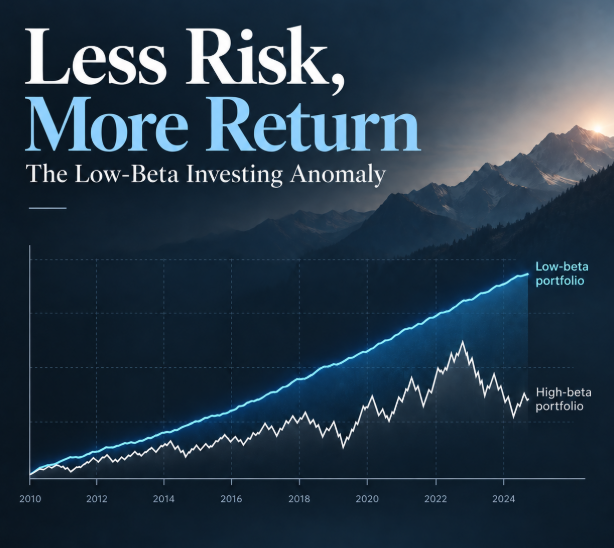
From a practical investing perspective, the thesis behind CAPM has not held up as expected. Subsequent quantitative research and empirical evidence revealed what is known as the low-beta anomaly, in which low-beta stocks often perform better than they should, while high-beta stocks typically underperform expectations.
In 2010, Malcolm Baker, Brendan Bradley, and Jeffrey Wurgler published the influential paper, Benchmarks as Limits to Arbitrage: Understanding the Low-Volatility Anomaly, In the paper, they state:
“While there are many candidates for the greatest anomaly in finance, perhaps the most worthy is the long-term success of low volatility and low beta stock portfolios. Over the 41 years between 1968 and 2008, low volatility and low beta portfolios have offered an enviable combination of high average returns and small drawdowns. This runs counter to the fundamental economic principle that risk is compensated with higher expected return.”
There are several explanations as to why the low-beta anomaly exists:
- Lottery preferences – Many market participants disproportionately prefer stocks with exciting upside potential, such as high-growth, speculative, high-beta stocks. Excess demand can leave these stocks overpriced, leading to underwhelming future returns.
- Leverage constraints – Some investors cannot use leverage and therefore buy high-beta stocks instead of buying low-beta stocks with leverage. Higher demand for high-beta names may lead to expensive valuations, depressing their future returns.
- Limits to arbitrage – Exploiting this anomaly requires leverage, short selling, and a tolerance for substantial benchmark deviation – all of which can be difficult in practice.
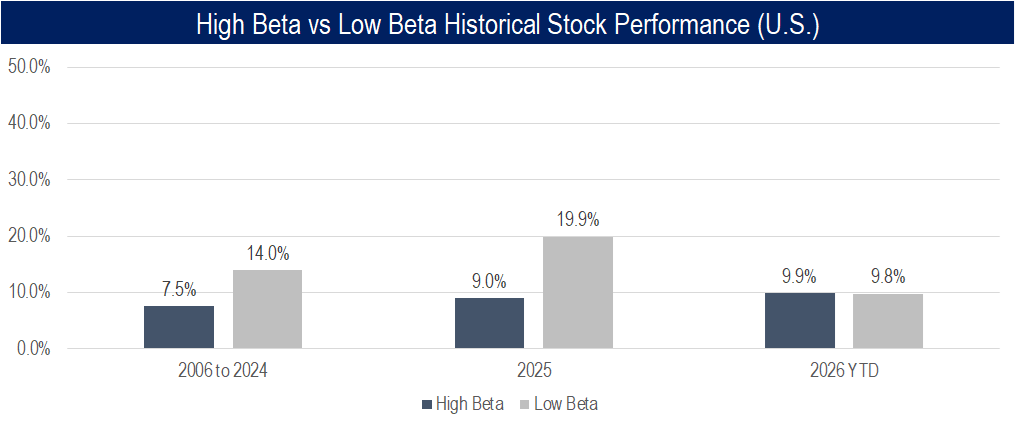
For example, in the U.S. stock market between 2006 and 2024, low-beta stocks outperformed high-beta stocks by 6.5% per year. In 2025, they outperformed by more than 10%. This year, performance between the cohorts is nearly even.
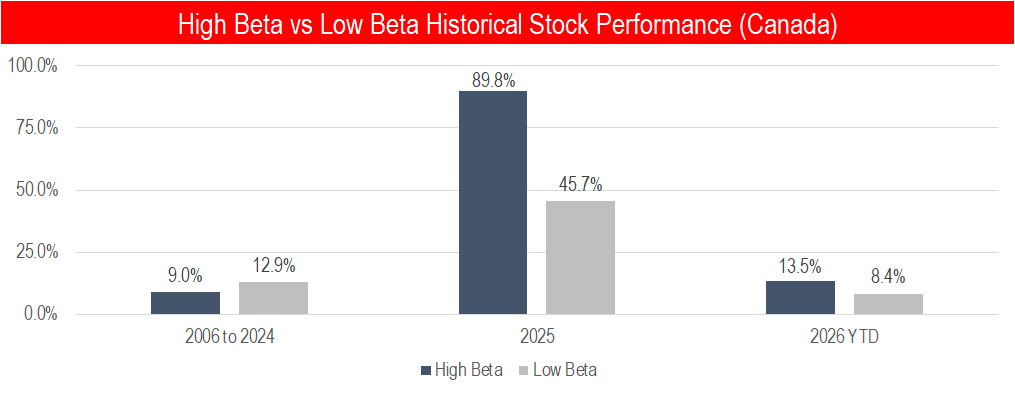
In the Canadian market, we see similar results. Between 2006 and 2024, low-beta stocks outperformed their high-beta brethren by nearly 4% per annum. However, Canadian low-beta stocks have underperformed high-beta names both last year and year-to-date.
Source: Accelerate
Textbook quantitative finance suggests investors should earn greater returns by taking more risk. However, the low-beta anomaly showcases that investors have historically been poorly compensated for taking on that risk and, in some cases, have earned far less return for taking far greater risk.
Nevertheless, from a portfolio manager’s standpoint, the data show that going long low-beta stocks while shorting high-beta stocks can be an attractive investment strategy. In practice, factor investing can work best from a risk-reward perspective as part of a broader multi-factor composite signal. A more sustainable use of the low-beta anomaly is not as a standalone rule, but as a component of a broader multi-factor model that combines a myriad of proven risk premia. To help facilitate idea generation, we highlight one top-decile stock that is forecasted to outperform and one bottom-decile stock that is predicted to underperform based on Accelerate’s multi-factor composite model in this month’s AlphaRank Top Stocks.
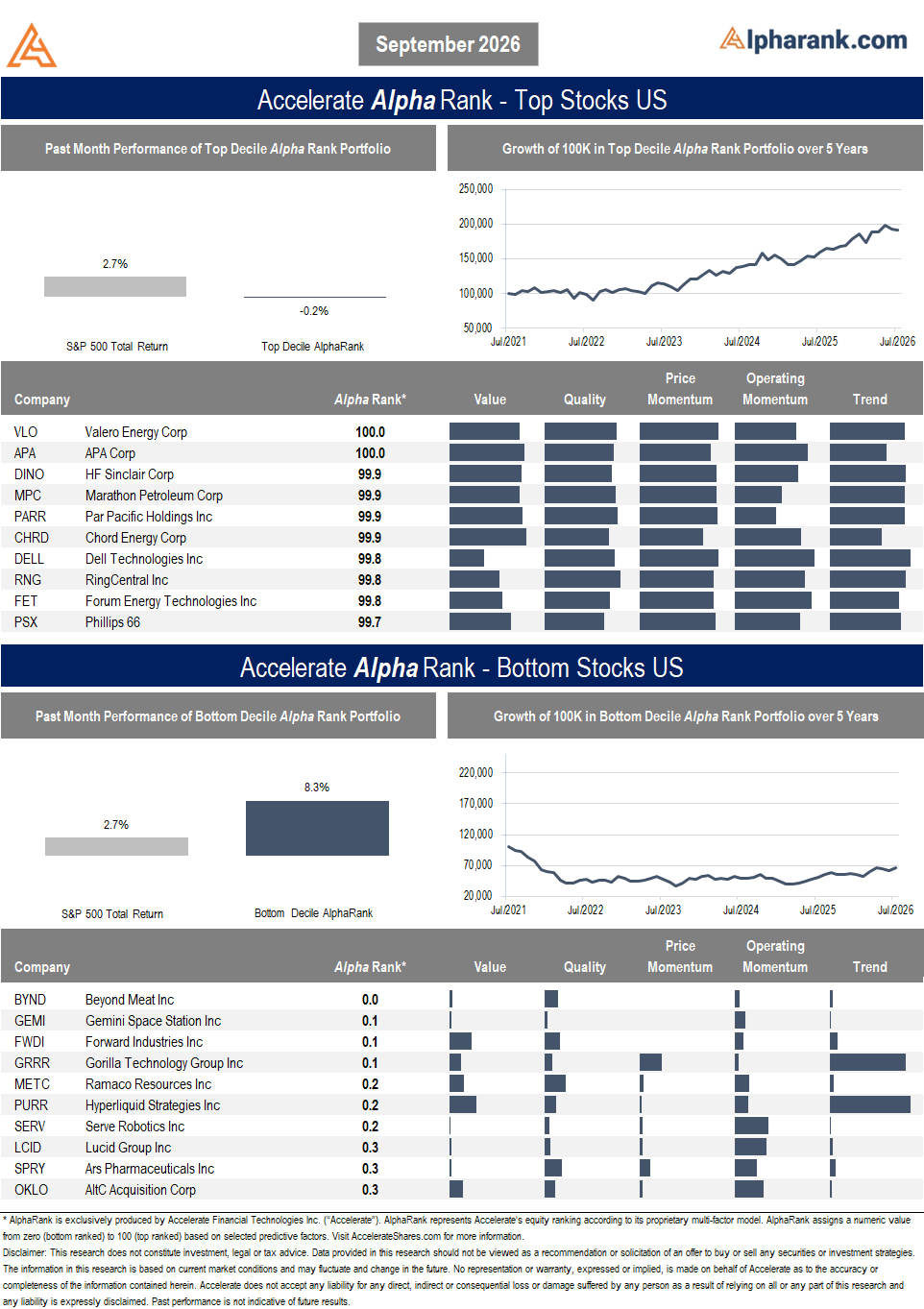
OUTPERFORM: RingCentral Inc (NYSE: RNG) is a cloud communications software company. Its core product replaces traditional business phone systems with cloud-based voice, messaging, video, contact-center and customer-engagement tools. Increasingly, RingCentral is positioning itself around AI-powered customer engagement, including AI agents, conversation intelligence and contact-center applications layered on top of its communications infrastructure. RingCentral has an attractive 8.1% free cash flow yield and has been aggressively repurchasing its shares. Moreover, the company has repeatedly raised guidance and beaten expectations. With positive share price momentum, along with an AlphaRank score of 99.8/100, we expect RNG shares to continue to outperform. Disclosure: Long RNG in the Accelerate Absolute Return Fund (TSX: HDGE).
UNDERPERFORM: Beyond Meat Inc (NASDAQ: BYND) is a producer of plant-based meat alternatives. It recently completed a 1-for-30 reverse stock split (never a good sign). From a fundamental perspective, demand for its products is shrinking, while margins remain extremely weak and revenue is declining. BYND’s negative operating cash flow has left it funding losses by diluting shareholders. With negative share price momentum and an AlphaRank score of 0.0/100, we expect BYND shares to continue to underperform.
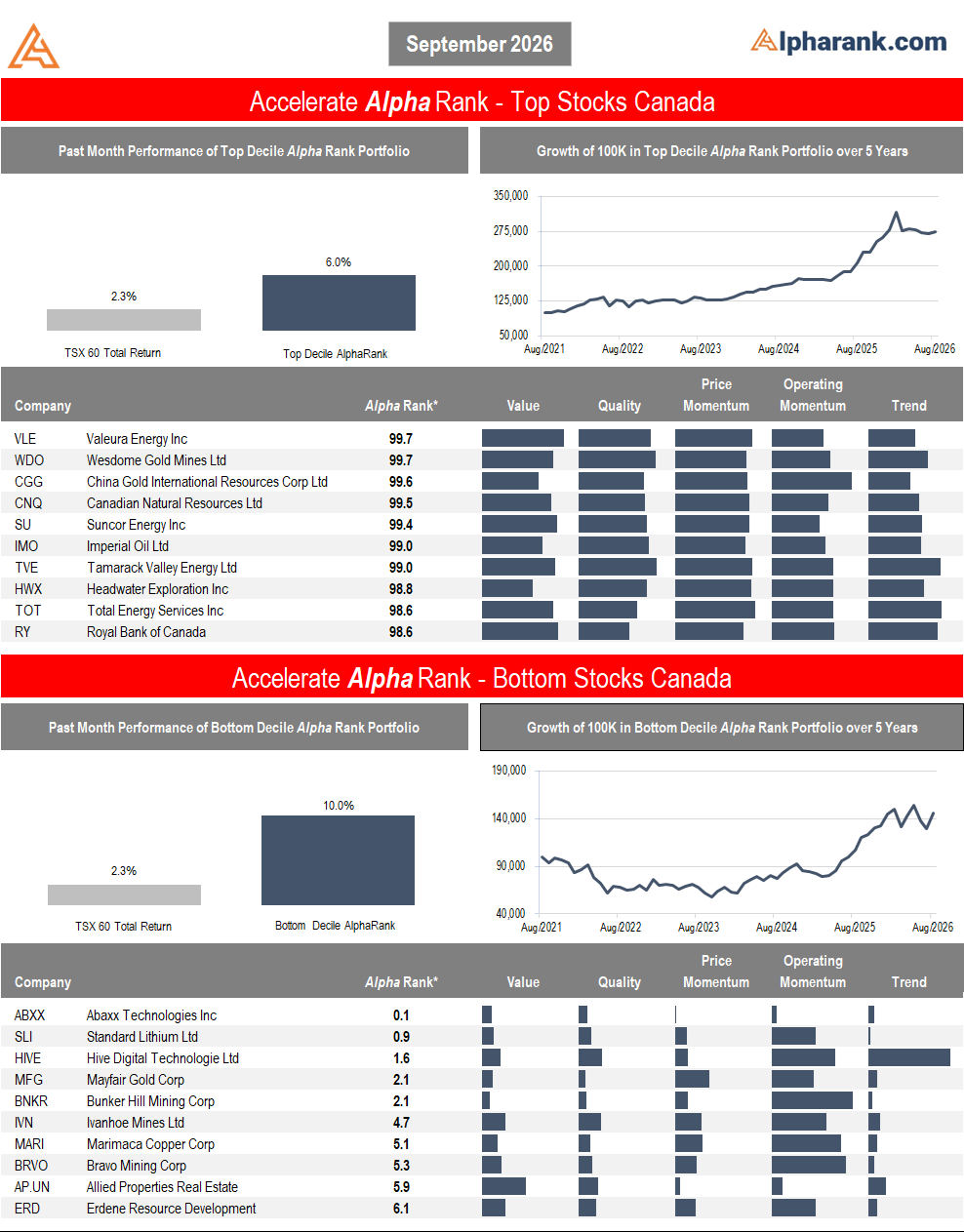
The AlphaRank Top and Bottom stock portfolios exhibited challenged relative performance last month:
- In Canada, the top-ranked AlphaRank portfolio of stocks increased by 6.0%, outperforming the benchmark’s 2.3% gain, while the bottom-ranked portfolio of Canadian equities jumped by 10.0%. The long-short portfolio (top minus bottom-ranked stocks) declined by -4.0%, as the top-ranked stocks underperformed the bottom-ranked securities. Over the past five years, the top decile AlphaRank portfolio has gained 174%, while the bottom-ranked portfolio has risen by 45%.
- In the U.S., the top-decile-ranked equities fell by -0.2%, underperforming the S&P 500’s 2.7% gain. Meanwhile, the bottom-ranked stocks gained 8.3%, resulting in an -8.5% loss for the top decile minus the bottom decile long-short portfolio. Over the past five years, the top-ranked U.S. equities have gained 91%, while the bottom-ranked portfolio has declined by -33%.
AlphaRank Top Stocks represents Accelerate’s predictive equity ranking powered by proven drivers of return. Stocks with the highest AlphaRank are projected to outperform, while stocks with the lowest AlphaRank are anticipated to underperform. AlphaRank assigns a numeric value to each security, ranging from 0 (bottom-ranked) to 100 (top-ranked), based on selected predictive factors. All Canadian and U.S. stocks priced above $1.50 per share and with a market capitalization exceeding $100 million are evaluated. In both the Accelerate Absolute Return Fund (TSX: HDGE) and the Accelerate Canadian Long Short Equity Fund (TSX: ATSX), Accelerate funds may be long many top-ranked stocks and short many bottom-ranked stocks. See AccelerateShares.com for more information.