November 15, 2026 – “The graveyards are full of indispensable men,” an aphorism often attributed to Charles de Gaulle, stands as a warning against the belief that any one person, regardless of their power, talent, or importance, is irreplaceable.
With artificial intelligence-related investment accounting for nearly 40% of U.S. real GDP growth last year (according the Federal Reserve Bank of St. Louis) as well as a material portion of global economic growth, any retrenchment in AI-related capital expenditures represents a significant risk to the world’s economy. Moreover, with stocks that are exposed to the broad AI ecosystem representing nearly half of the market capitalization of the S&P 500 and approximately 20% of the global stock market (along with a rapidly rising portion of the corporate bond market), risks to the AI buildout amount to perhaps the biggest threat to investors today.
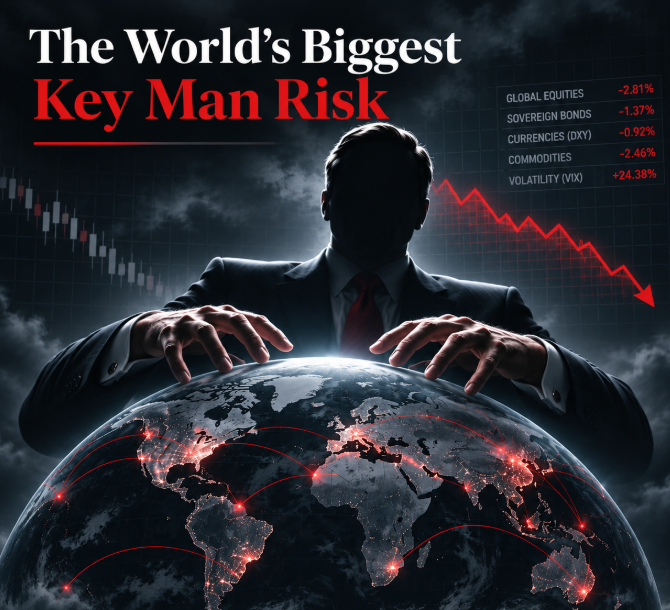
Key man risk represents the risk that an organization suffers substantial operational or financial damage from the unexpected loss of an individual critical to its success. Semiconductor company Nvidia sits at the heart of the global AI industry, supplying the leading computing infrastructure (Graphics Processing Units or GPUs) that powers super intelligence. Its GPUs are needed to run and train leading models, making the company foundational to hyperscalers, AI labs, and tech companies worldwide.
Jensen Huang was more than just the co-founder and former CEO (until last week) of Nvidia. He was the principal architect of the AI revolution — its leading technologist, global spokesman, and chief promoter. Under Huang’s direction, Nvidia went from a small company making graphics chips for video games to the world’s leading AI infrastructure company and the largest company on the planet (until Apple recently took back the crown). His unique combination of technical knowledge (he’s an electrical engineer), supplier relationships, government connections, industry credibility and vision made him the most important person at the most important company in the most important industry.
In the current environment, the growth of both the global economy and capital markets is heavily reliant on the AI ecosystem, which is extremely dependent on Nvidia, whose strategy and competitive position remain closely associated with Jensen Huang.
Talk about key man risk.
Over the past week, as Huang’s transgressions were revealed, and ultimately led to his resignation as CEO, Nvidia’s market cap has declined by more than $500 billion. The market has recognized the gravity of the situation, indicating that Jensen’s value to Nvidia exceeds half of one trillion dollars.
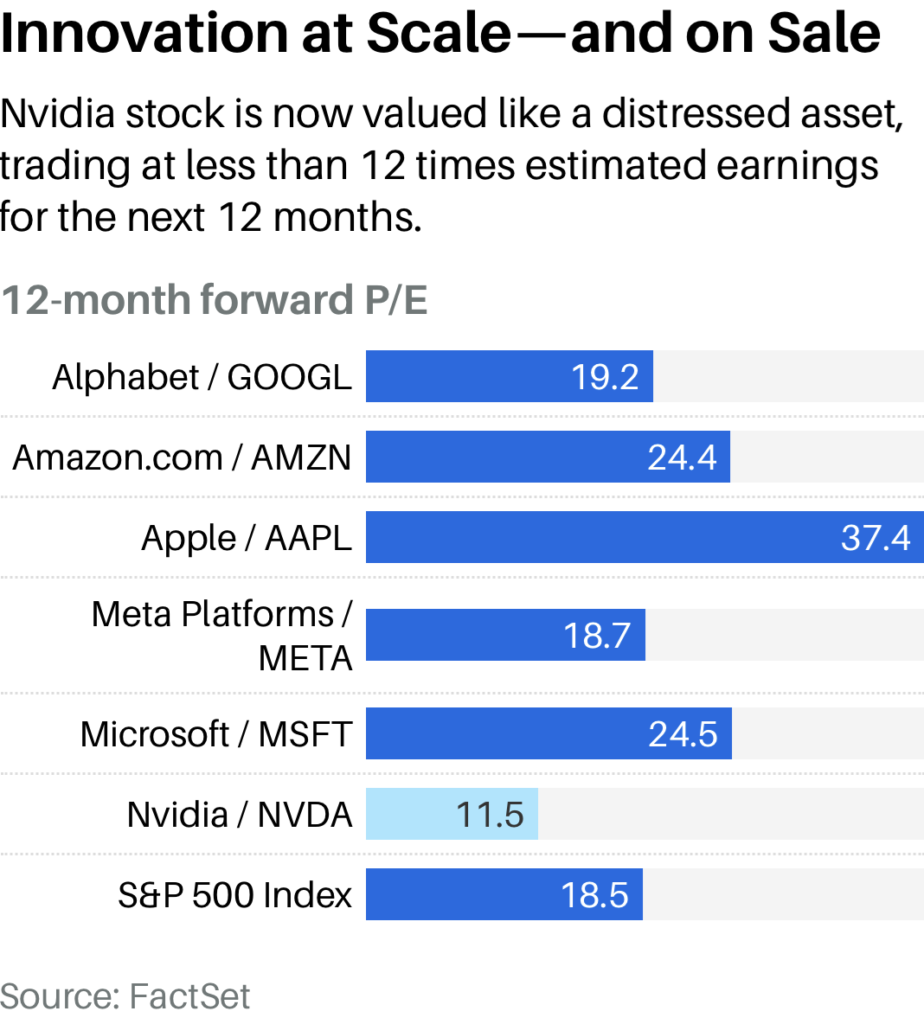
While investor sentiment toward the AI theme peaked this past summer, Jensen’s departure from Nvidia has resulted in the stock trading down to just 12x forward earnings, its lowest valuation in recent memory and a significant discount to the S&P 500’s 18x earnings multiple.
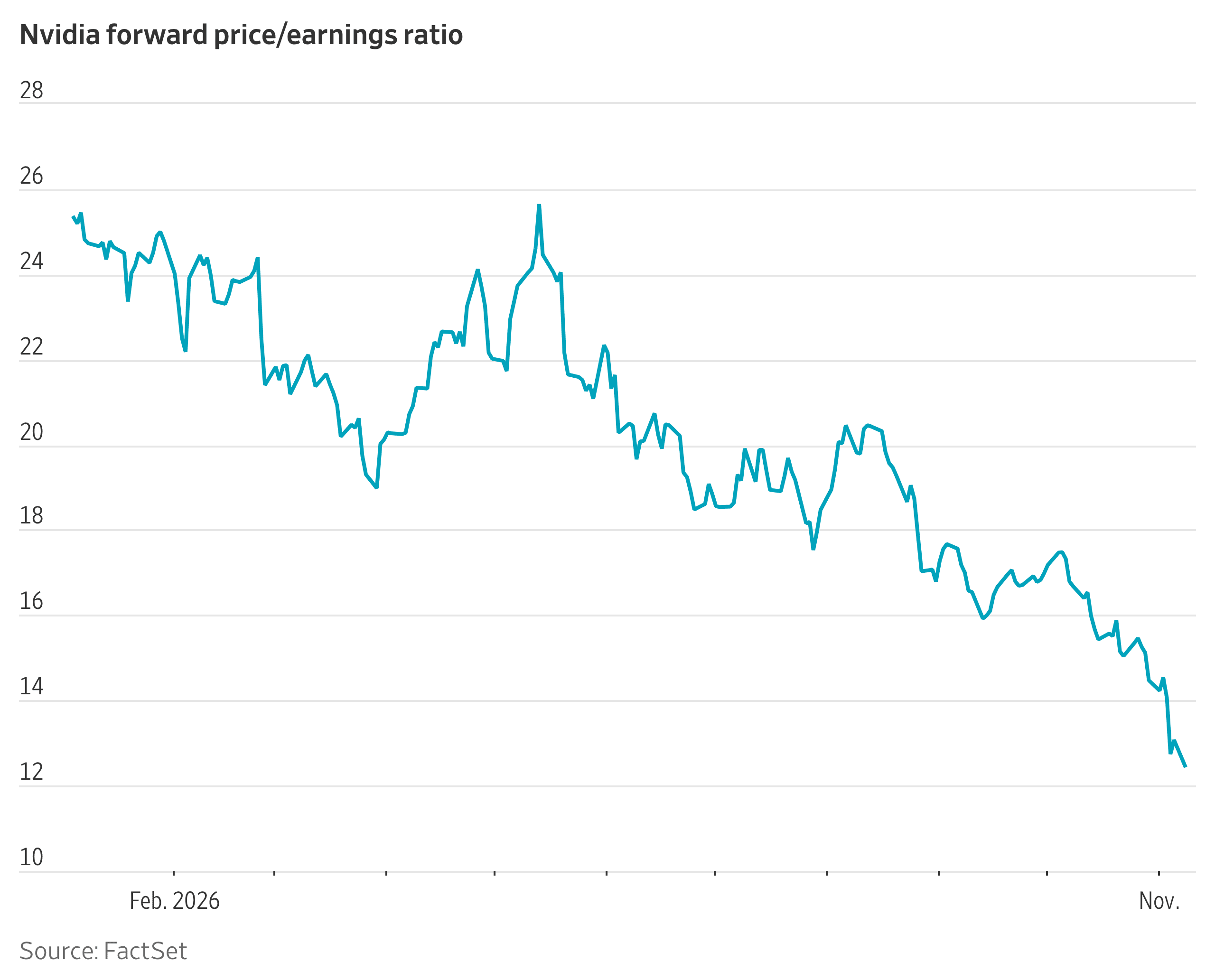
Moreover, despite being the largest contributor to the S&P 500’s forecast earnings growth, Nvidia now trades at a substantial discount to its large cap tech peers.
Nevertheless, uncertainty surrounding the leadership and direction at the foundation of the AI ecosystem reaches far beyond just one company. Nvidia has become one of the world’s largest venture capital investors, particularly related to artificial intelligence. Year-to-date, it is the world’s most active startup investor, backing more than 120 companies. It was also the top investor in venture rounds exceeding $500 million.
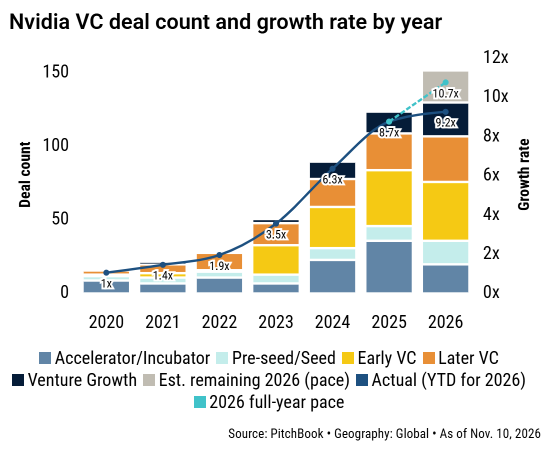
Currently, Nvidia owns well over $100 billion of investments and commitments, including acquisitions, public company stakes, and startup financing.
There is a reason Nvidia is known as “the central bank of AI.”
The company is far more than just a GPU business. Its investment activity and supplier commitments have created a vast and tangled web of circular financing relationships throughout the tech industry. For example, AI developers and cloud companies raise financing to buy GPUs, generating profits for Nvidia, which in turn supports financing and expansion across the ecosystem. Moreover, the demand for compute has created a business model known as neoclouds, which raise financing to buy GPUs and build data centers, effectively serving as off-balance sheet financing vehicles for Nvidia.
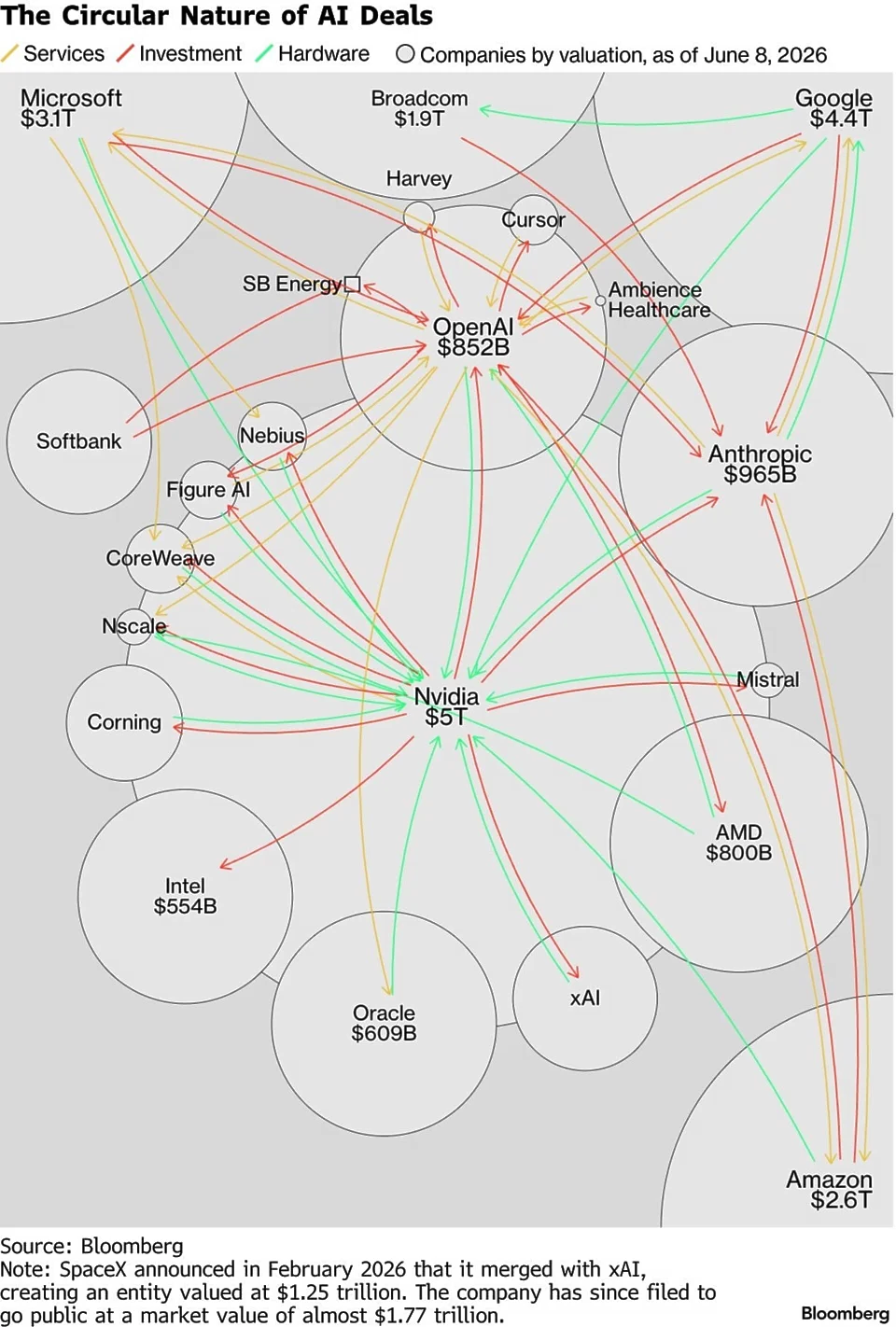
It was often Jensen Huang architecting these deals, which have been woven into a multi-trillion-dollar web of financial transactions and interdependent relationships that no one fully understands. This extraordinary concentration and interdependency create a systemic vulnerability. A disruption to Nvidia’s strategic direction, technology, supply chain, financial performance, and leadership could reverberate not only through the AI ecosystem, but the global economy writ large.
One clear result is that risk has increased, investor sentiment has softened, and uncertainty regarding the growth of the AI ecosystem has risen. Jensen’s resignation will not be the last shoe to drop.
This is not to say the AI growth story is over, or that all securities within the ecosystem will continue to struggle. The AI revolution represents one of the most consequential technological developments in modern history. Nvidia is a strong, highly profitable company with a very competent and capable workforce. No one is truly indispensable, and organizations can continue to do well after a visionary founder-CEO leaves (look no further than Apple and Tim Cook, who took over for the legendary Steve Jobs). It would come as no surprise for Nvidia to get a new CEO who is world-class, nor would it be shocking if Jensen were to be reinstated as CEO and things went back to business as usual at the world’s most important company.
However, investors should be mindful of the risks that this AI ecosystem disruption presents. It would be wise for investors to seek to diversify portfolios outside of the AI-heavy indexes (note the recent outperformance of the S&P 500 equal-weight index over the market-cap weighted index).
Moreover, as the world’s biggest key man risk unravels, investors may seek to allocate to asset classes that are not reliant on the success of the AI ecosystem. History is littered with transformative technologies that changed the world while destroying capital for investors who paid too much for the companies driving their adoption.
Maintaining exposure to differentiated return drivers and strategies less dependent on the success of the AI ecosystem may prove increasingly valuable.
Accelerate manages five alternative investment solutions, each with a specific mandate:
- Accelerate Arbitrage Fund (ETF Ticker: ARB, Series F: AFT201, Advisor Series: AFT200) – Merger Arbitrage
- Accelerate Absolute Return Fund (ETF Ticker: HDGE, Series F: AFT101, Advisor Series: AFT100) – Absolute Return
- Accelerate OneChoice Alternative Multi-Asset Fund (ETF Ticker: ONEC, Series F: AFT401, Advisor Series: AFT400) – Multi-Asset
- Accelerate Canadian Long Short Equity Fund (ETF Ticker: ATSX, Series F: AFT301, Advisor Series: AFT300) – Long Short Equity
- Accelerate Diversified Credit Income Fund (ETF Ticker: INCM / INCM.B / INCM.U, Series F: AFT501 / AFT501H, Advisor Series: AFT500 / AFT500H) – Private Credit
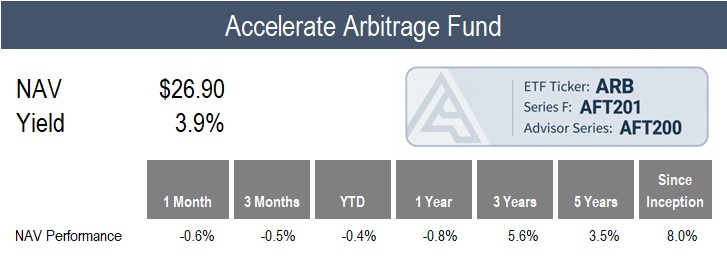
ARB declined -0.6% in October as SPAC arbitrage spreads widened markedly.
During the month, the Fund allocated to seven new merger arbitrage investments, including two Canadian and five American. Moreover, the Fund exited two merger arbitrage investments, including Paramount’s acquisition of Warner Bros. Discovery and Dream Finders Homes merger with Beazer Homes USA, after their transactions were completed.
Currently, ARB is 174.8% long and -0.6% short (175.4% gross exposure), with 81% allocated to SPAC arbitrage and 19% to merger arbitrage (with 7% in LBOs and 12% in strategic M&A).

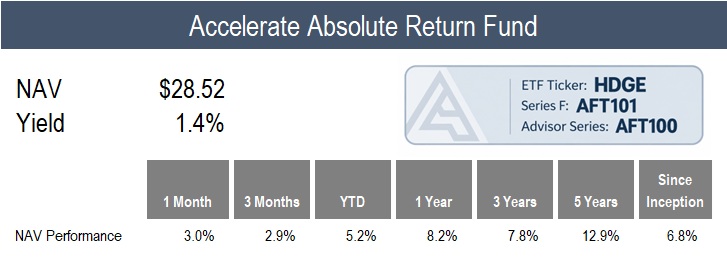
In October, HDGE returned 3.0%, primarily driven by its short portfolio.
Multi-factor long short equity strategies experienced one of their best monthly performances of the year in October, buoyed by the value and quality factor baskets, which both generated double-digit alpha. All other market neutral factor portfolios generated positive performance for the month, primarily from their short positions. For reference, the GS Most Shorted Basket (which is focused on the market’s lowest quality stocks) plunged -9.7%, bolstering the long short equity proxy for a 2.2% return last month.
Top Fund contributors include a short position in CoreWeave, along with long positions in Aritzia and AMN Healthcare Services. Top Fund detractors include short positions in Portillo’s and Capri Holdings, as well as a long position in Wesdome Gold Mines.
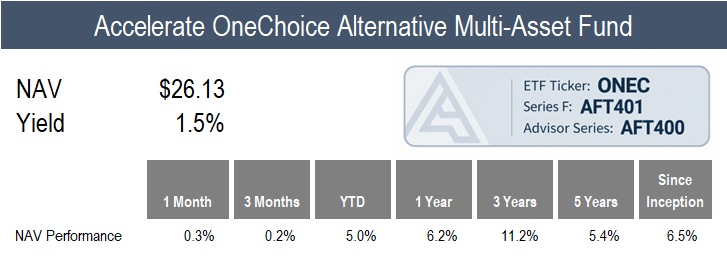
ONEC returned 0.3% in October as the Fund posted mixed results across its alternative asset classes.
The top contributor for the Fund was its infrastructure allocation, which gained 7.0%. In addition, the Fund’s real estate, long short equity, absolute return, and risk parity allocations produced returns of between 2% and 3%.
In contrast, the largest detractor was gold, which declined by -6.3%. Moreover, the Fund’s private credit, merger arbitrage, managed futures, and commodities allocations produced flat or small losses for the month.
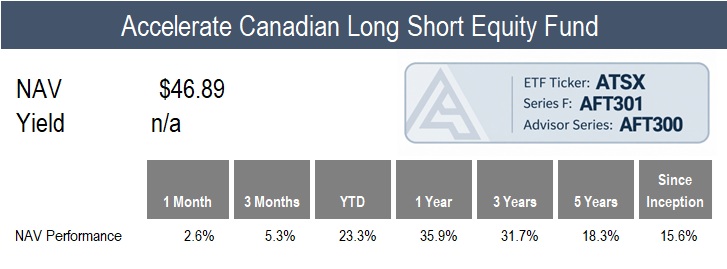
ATSX gained 2.6% for the month compared to the benchmark S&P/TSX 60’s 2.8% return.
All Canadian long short factor portfolios were positive in October, supporting the Fund’s monthly gain. While the long factor portfolios performed modestly, the short factor portfolios generated the bulk of the return.
Top Fund contributors include short positions in Champion Iron and Fiera Capital, as well as a long position in Aritzia. Top Fund detractors include long positions in Discovery Silver, Wesdome Gold, and Fortuna Mining.
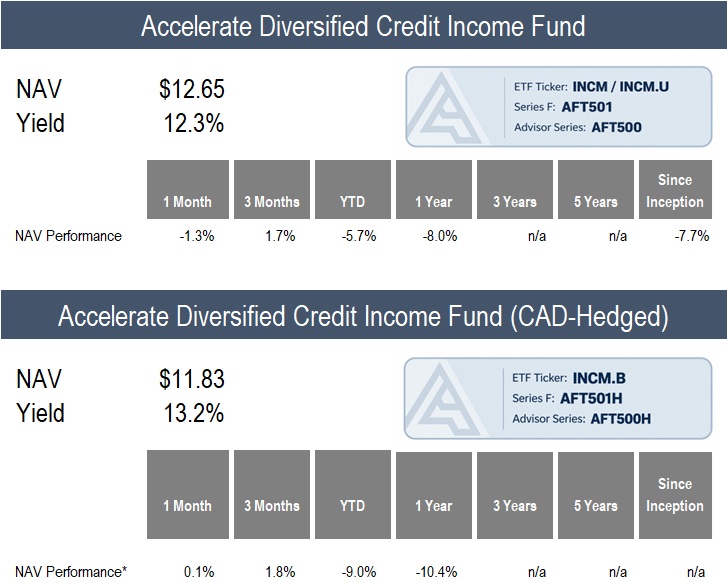
INCM declined by -1.3% (up by 0.1% on a CAD-hedged basis) in October as the average BDC NAV discount widened slightly.
That said, recent third quarter reporting by BDCs, which began near month-end and continued in earnest throughout the first week of November, points to a continued recovery in private credit performance. Including month-to-date Q3 results, BDCs are set for their best fundamental performance in a year. That said, investors can expect Accelerate’s quarterly private credit monitor, which will include a deep dive into Q3 results, later this month.
Currently, INCM is allocated to 20 private credit portfolios (through listed BDCs), totalling more than 5,000 loans and investments, of which 84.6% are senior secured and 90.4% are floating rate. The current yield on the INCM portfolio is 12.6%, and it trades at a -22.6% discount to its net asset value. INCM’s exposure to software loans is 17.1% of its portfolio.
Have questions about Accelerate’s investment strategies? Click below to book a call with me:

-Julian
Disclaimer: This distribution does not constitute investment, legal or tax advice. Data provided in this distribution should not be viewed as a recommendation or solicitation of an offer to buy or sell any securities or investment strategies. Please read the relevant prospectus before investing. For a summary of the risks of an investment in the Accelerate ETFs, please see the specific risks set out in the prospectus. ETFs are not guaranteed and the information in this distribution is based on current market conditions and may fluctuate and change in the future. Past performance is not indicative of future results. Decisions regarding tax, investments, and all other financial matters should be made solely with the guidance of a qualified professional. Visit www.AccelerateShares.com for more information.