August 16, 2026 – In spring 2021, several media and technology stocks, such as Viacom, Baidu, and Discovery, experienced inexplicable and powerful rallies. Many had roughly doubled in the span of a couple of months on seemingly no news. These single-name stock moves had left traders scratching their heads.
As fast as these stocks skyrocketed, with no apparent catalyst, they began to plummet. Viacom fell -27% in a day and roughly -50% in a week. Discovery, Baidu, and Tencent Music stock all cratered on no news. The tape showed large block trades from Goldman Sachs and Morgan Stanley pressuring the securities.
Subsequently, it was unveiled that Bill Hwang’s family office, Archegos Capital Management, was responsible for the market volatility. The firm had accumulated enormous economic exposure to the problematic securities via total return swaps with multiple prime brokers. The firm had been margin-called, and the prime brokers rushed to unload the positions. The prime brokers that acted quickly escaped unscathed. Those that delayed suffered billions of dollars of losses.
The main driver behind the market action was leverage. At its peak, prosecutors later said that Archegos’ portfolio had more than $100 billion of exposure on just $10 billion of capital.
Once the carnage had concluded, the mystery behind the market volatility was exposed. A highly leveraged, unregulated financial entity took massive and concentrated exposures. All it took was a small negative catalyst – an equity offering from Viacom, which was capitalizing on its share price rally – to cause the house of cards to fall.
Last month, we discussed recent puzzling market action in AI and momentum stocks in two memos:
First, in The Great Rotation: “Despite the market’s apparent calm, considerable turbulence is building beneath the surface. Sector rotation and a debate around market leadership are brewing in an age-old battle between bulls and bears. Allocators are leaving breadcrumbs signalling the occurrence of a “great rotation” in the equity market, with investors recently moving from artificial intelligence winners to other segments of the equity market.”
Second, in the subsequent note, The Two Scariest Words in Investing: “This month, we witnessed a painful momentum factor unwind. The Goldman Sachs High Beta Momentum basket has declined by -21% over the past several weeks and is on track for its worst monthly performance since 2009. Accordingly, the long-short momentum factor has fallen by more than -20% over the past few weeks. ‘We’re dealing with one of the biggest momentum sell-offs on record.'”
While the stocks of AI beneficiaries were seeing earnings surge, their stock prices were crashing. For example, memory company Micron had its consensus earnings estimate jump by 45% in mid-July while its stock price fell -16%, down to an earnings multiple of 5x. At the time, we noted that it was “rare to see such a divergence between price and fundamentals but semis price action currently overwhelmed by momentum factor unwind + “great rotation” trade (sell AI winners / buy AI losers).”
As momentum and semiconductor names were crashing and software stocks were rallying, the equal-weight stock index held firm, displaying seemingly no signs of market carnage. This “tell” indicated the market unwind was concentrated, rather than systemic.
Just a couple of weeks after these head-scratching market moves occurred, the mystery behind the market volatility was revealed. Situational Awareness LP, a hedge fund founded by 25-year-old wunderkind Leopold Aschenbrenner, had taken concentrated, leveraged exposure to AI-winners, while short-selling software names that AI was supposed to disrupt. Effectively, it was a leveraged bet on the long-short momentum factor. Most importantly, the fund was leveraged at a reported 4:1, leaving little margin for error.
From a statistical perspective, a fund with volatility of 30% and 4x leverage would be expected to blow up once every one or two years. Additionally, the portfolio’s short positions did not serve as effective hedges, given their returns were driven by the same (but opposite) AI disruption factor driving the long positions. All it took was a couple of weeks of volatility for the fund to get margin-called.
Moreover, it is speculated that other hedge funds caught on to the troubles brewing at Situational Awareness. Smelling blood in the water, they put on the reverse positions, seeking to profit from the unwind by short-selling AI-exposed names and buying AI-losers (software stocks) while coincidentally further pressuring the positions at the hedge fund in trouble.
When those opportunistic investors, along with other traders capitalizing on the unwind, learned that hedge fund giant Citadel would acquire Situational Awareness’ entire equity portfolio, halting the margin call, they rushed to adjust their positions. AI and momentum stocks rallied hard. Moreover, the demand for long equity exposure was so intense that it set a one-day record of approximately 4 million bullish calls on the S&P 500 traded on August 4th.
The “breadcrumbs” driving unexplained market volatility that we previously noted were subsequently revealed to be a large hedge fund margin call and concurrent factor unwind. The divestment of the fund’s portfolio and settlement of its margin call provided a market-clearing event, allowing for normalcy (if we can ever call it that) to return.
Market mystery solved.
Accelerate manages five alternative investment solutions, each with a specific mandate:
- Accelerate Arbitrage Fund (TSX: ARB): Merger Arbitrage
- Accelerate Absolute Return Fund (TSX: HDGE): Absolute Return
- Accelerate OneChoice Alternative Multi-Asset Fund (TSX: ONEC): Multi-Asset
- Accelerate Canadian Long Short Equity Fund (TSX: ATSX): Long Short Equity
- Accelerate Diversified Credit Income Fund (TSX: INCM): Private Credit
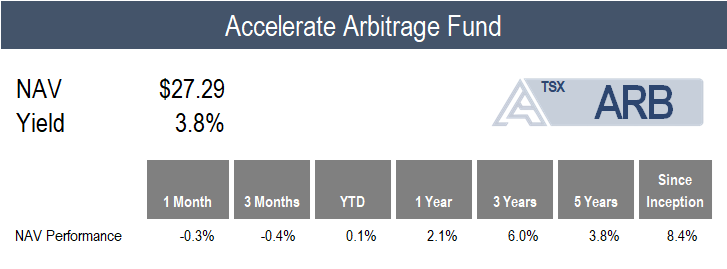
ARB declined -0.3% in July compared to the benchmark S&P Merger Arbitrage Total Return Index’s 0.5% gain.
The Fund invested in 1 merger arbitrage deal (out of 17 announced) and 14 SPAC IPOs (out of 18 new listings).
ARB did experience one deal termination, which contributed to its underperformance over the past couple of months. Zijin Gold’s $5.5 billion acquisition of Allied Gold collapsed after it failed to secure regulatory approval from China’s NDRC. The regulatory failure was unexpected, given that the NDRC was previously a rubber stamp for Chinese outbound M&A and had never denied a transaction in recent history (while approving thousands). Moreover, Zijin Gold’s parent, Zijin Mining, has been an active buyer of TSX-listed companies – acquiring three since 2020. ARB participated in the previous deals with great results – in particular, Zijin’s bidding war for Guyana Goldfields in 2020 was one of the Fund’s most lucrative investments that year. While we will never know why the regulator killed Zijin’s acquisition of Allied Gold (many rumours are floating about), what we do know is that the action will take Chinese outbound M&A off the table for the foreseeable future.
Currently, ARB is 158.4% long and -3.1% short (161.5% gross exposure), with 79% allocated to SPAC arbitrage and 21 to merger arbitrage (with 7% in LBOs and 14% in strategic M&A).

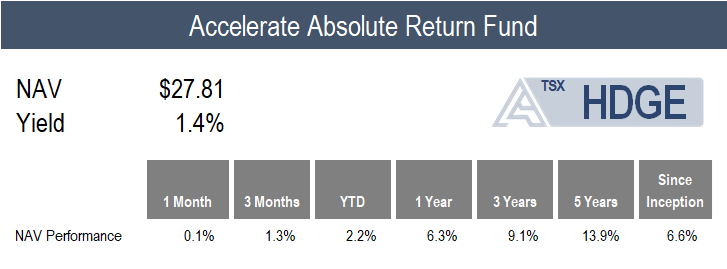
HDGE ticked up by 0.1% in July.
While the equity market appeared to be relatively calm throughout the month, U.S. long-short factor performance was unusually volatile. While composite multi-factor long-short performance was positive in July, its contributors produced a wide range of results. For example, the U.S. long-short value and quality portfolio generated returns of more than 15%, while the market neutral trend portfolio lost nearly -18%. The Fund’s hedged construction through a composite of uncorrelated long-short factors helps restrain underlying volatility, generating a smoother and uncorrelated return profile.
Top Fund contributors include long positions in RingCentral and HF Sinclair, as well as a short position in Roblox. Top Fund detractors include short positions in CBIZ and Clearwater Paper, along with a long position in SanDisk.
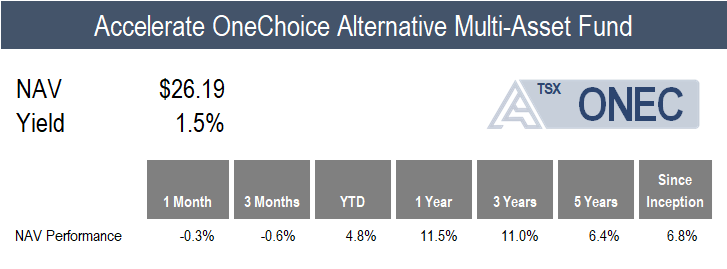
ONEC declined -0.3% in a relatively tame month for alternative asset classes.
Positive contributors to the Fund’s return include long short equity and commodities, which gained 3.7% and 3.5%, respectively. In addition, the Fund’s real estate, managed futures, and leveraged loan holdings generated returns of around 1.0%. ONEC’s merger arbitrage, absolute return, and gold allocations were approximately flat for the month.
Negative contributors include private credit, infrastructure, and risk parity, which declined between -1.6% and -3.8%.
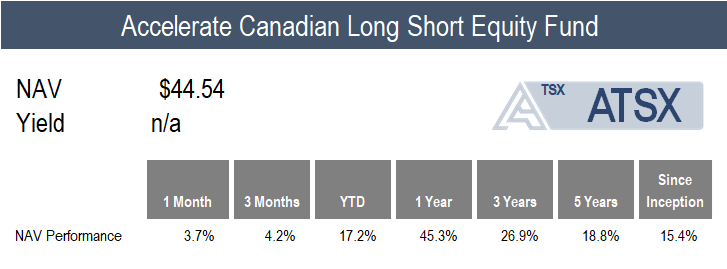
ATSX gained 3.7% in July compared to the benchmark S&P/TSX 60’s 1.8% return.
Canadian multi-factor performance was mixed for the month, with the long-short value and quality portfolio generating positive alpha, while the price momentum and trend factors notched negative returns.
Top Fund contributors include long positions in Mattr, Suncor Energy, and Cenovus Energy. Top Fund detractors include short positions in Thomson Reuters and Gibson Energy, along with a long position in Trican Well Service.
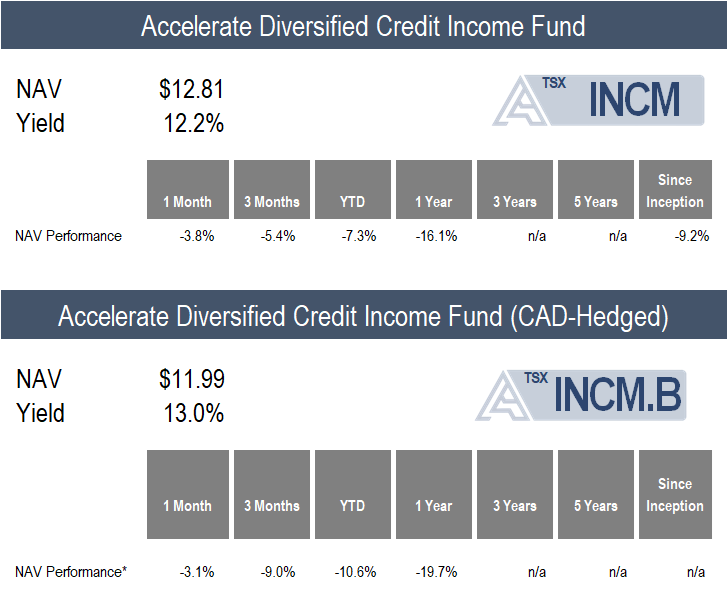
INCM declined -3.8% (-3.1% in CAD-hedged terms) in July, primarily due to NAV discounts widening. The Fund’s average NAV discount declined to -26.6% from -22.1% at the end of June.
Currently, INCM is allocated to 20 private credit portfolios (through listed BDCs), totalling more than 5,000 loans and investments, of which 84.2% are senior secured and 90.1% are floating rate. The current yield on the INCM portfolio is 12.2%, and it trades at a -26.6% discount to its net asset value. INCM’s exposure to software loans is 16.4% of its portfolio.
Have questions about Accelerate’s investment strategies? Click below to book a call with me:

-Julian
Disclaimer: This distribution does not constitute investment, legal or tax advice. Data provided in this distribution should not be viewed as a recommendation or solicitation of an offer to buy or sell any securities or investment strategies. Please read the relevant prospectus before investing. For a summary of the risks of an investment in the Accelerate ETFs, please see the specific risks set out in the prospectus. ETFs are not guaranteed and the information in this distribution is based on current market conditions and may fluctuate and change in the future. Past performance is not indicative of future results. Decisions regarding tax, investments, and all other financial matters should be made solely with the guidance of a qualified professional. Visit www.AccelerateShares.com for more information.