July 20, 2026 – Growing up in the 1990s was a formative experience. Back then, there were many novel forms of entertainment that came and went, and that the current generation seemingly no longer gets to enjoy. Specifically, playing arcade games was arguably one of the most fun things to do in that time period.
One particular game stood out at the time – Mortal Kombat. There were several features to the game that made it rise above the rest. Its digitized actors, its theatrical nature, and most importantly, its fatality system that ended each match in a distinctly violent fashion (and probably something not fit for a 9 year old boy to be playing!). Nevertheless, I found the game so compelling that I managed to spend all of the collectible quarters from my coin collection playing Mortal Kombat that summer.
As expected, my bank roll of quarters was limited, so I was never able to get any good at the game. As a result, I often was at the receiving end of a game-ending fatality, and with that, frequently witnessed the two scariest words in gaming:
Game over.
Those two words – game over – represent the moment when every mistake catches up, every chance disappears, and the only thing left is the choice to walk away or to insert another quarter to keep playing.
Similar to gamers, different contingents of investors face a comparable set of those two daunting words.
For example, long-only investors shudder to think about their two scariest words – bear market. Merger arbitrageurs feel their hearts jump when they think about their two scariest words – deal terminated. Short sellers have nightmares about a “short squeeze”. And lastly, quantitative investors constantly stress over what’s known as a “factor unwind”.
A factor unwind occurs when a widely held investment factor, such as momentum, value, or quality, suddenly reverses, forcing investors positioned around that factor to exit simultaneously. Since factor investing is often implemented within long-short equity strategies, the net effect can be especially painful because both sides can lose at the same time. For instance, take a momentum factor pair, which consists of a stock portfolio long of recent winners and short of recent losers. During an unwind, market leadership abruptly reverses. The former winners fall, hurting the long book, while the former losers rally, hurting the short book. In a momentum factor unwind scenario in which the long momentum portfolio falls by -3% and the short momentum portfolio rises by 3%, the long-short investor experiences a -6% loss. This is sometimes called a momentum crash.
Reinforcing the momentum crash in a negative feedback loop occurs when systematic funds respond to the losses and volatility by cutting leverage (so called “de-grossing”). To reduce exposure and manage risk, they sell their momentum winners and buy back their momentum shorts – the exact trades that push the factor further against them.
Ergo, a market-neutral factor strategy, such as momentum, may incur significant losses even when the overall market barely moves. The momentum factor’s risk is not primarily market direction. The main risk is the spread between yesterday’s winners and yesterday’s losers collapsing, or violently reversing.
In last month’s memo, Momentum: The Anomaly That Wouldn’t Die, we wrote about the historically attractive results of a long-short momentum investment strategy. In the memo, we wrote:
Academic research has repeatedly shown that the market does not fully incorporate information instantaneously. Stocks with strong trailing 12-month performance tend to continue outperforming over intermediate horizons, suggesting that investor underreaction, slow information diffusion, and self-reinforcing capital flows can turn recent winners into future winners. Conversely, stocks with poor trailing 12-month performance tend to continue to underperform in the near term.
Paradoxically, factor investing works partly because it periodically fails. Factors such as momentum earn a premium only because investors must endure uncomfortable stretches of underperformance, reversals, and drawdowns. Those difficult periods drive impatient investors away, prevent the strategy from becoming universally crowded, and compensate disciplined investors for bearing behavioural and market risk.
If a factor worked reliably all the time, everyone would own it and its excess return would disappear. Its inconsistency is what helps preserve its long-term opportunity.
This month, we witnessed a painful momentum factor unwind. The Goldman Sachs High Beta Momentum basket has declined by -21% over the past several weeks and is on track for its worst monthly performance since 2009.
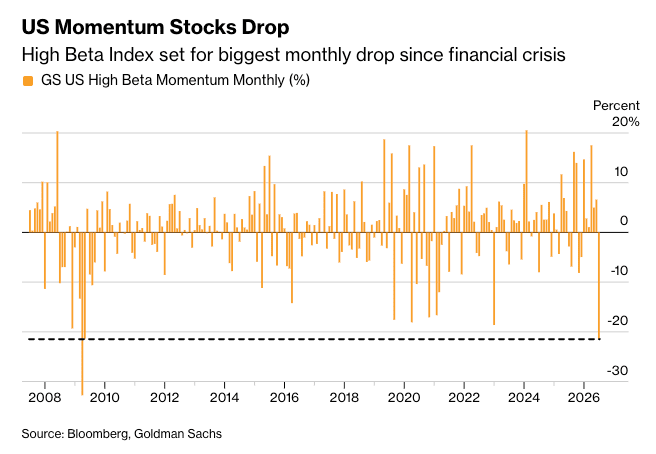
Accordingly, the long-short momentum factor has fallen by more than -20% over the past few weeks. “We’re dealing with one of the biggest momentum sell-offs on record,” said Christian Mueller-Glissmann, head of asset allocation research at Goldman Sachs. “It’s been three weeks of washout.”
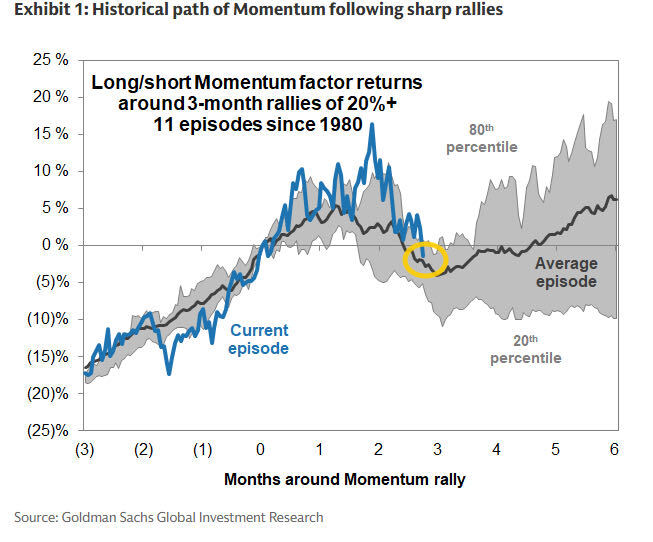
Ultimately, factor unwinds are ephemeral. They end when the forced trading runs out and fundamentals take over. These episodes are short term in nature and typically last several days to weeks. The current momentum factor crash is tracking its historical precedents, and if this continues, appears to be near the end of its duration.
Nevertheless, it is important to note that although they can be painful, factor unwinds are not necessarily driven by deteriorating company fundamentals. Stocks may fall (and shorts may rise) because they share an investment characteristic that investors are urgently trying to shed.
Unlike the game over screen in the arcade, investors get to continue for free after a factor unwind, as long as they prudently manage risk and survive until the factor crash concludes.
That said, from a portfolio manager’s standpoint, the data show that momentum factor investing, particularly from a long-short perspective, can be an attractive investment strategy. In practice, momentum factor investing can work best from a risk-reward perspective as part of a broader multi-factor composite signal. The best use of the price momentum factor is not as a standalone “buy the top performing stocks” rule, but as a component of a broader multi-factor model that combines price momentum with earnings quality, valuation, earnings revisions, and others. To help facilitate idea generation, we highlight one top-decile stock that is forecasted to outperform and one bottom-decile stock that is predicted to underperform based on Accelerate’s multi-factor composite model in this month’s AlphaRank Top Stocks.
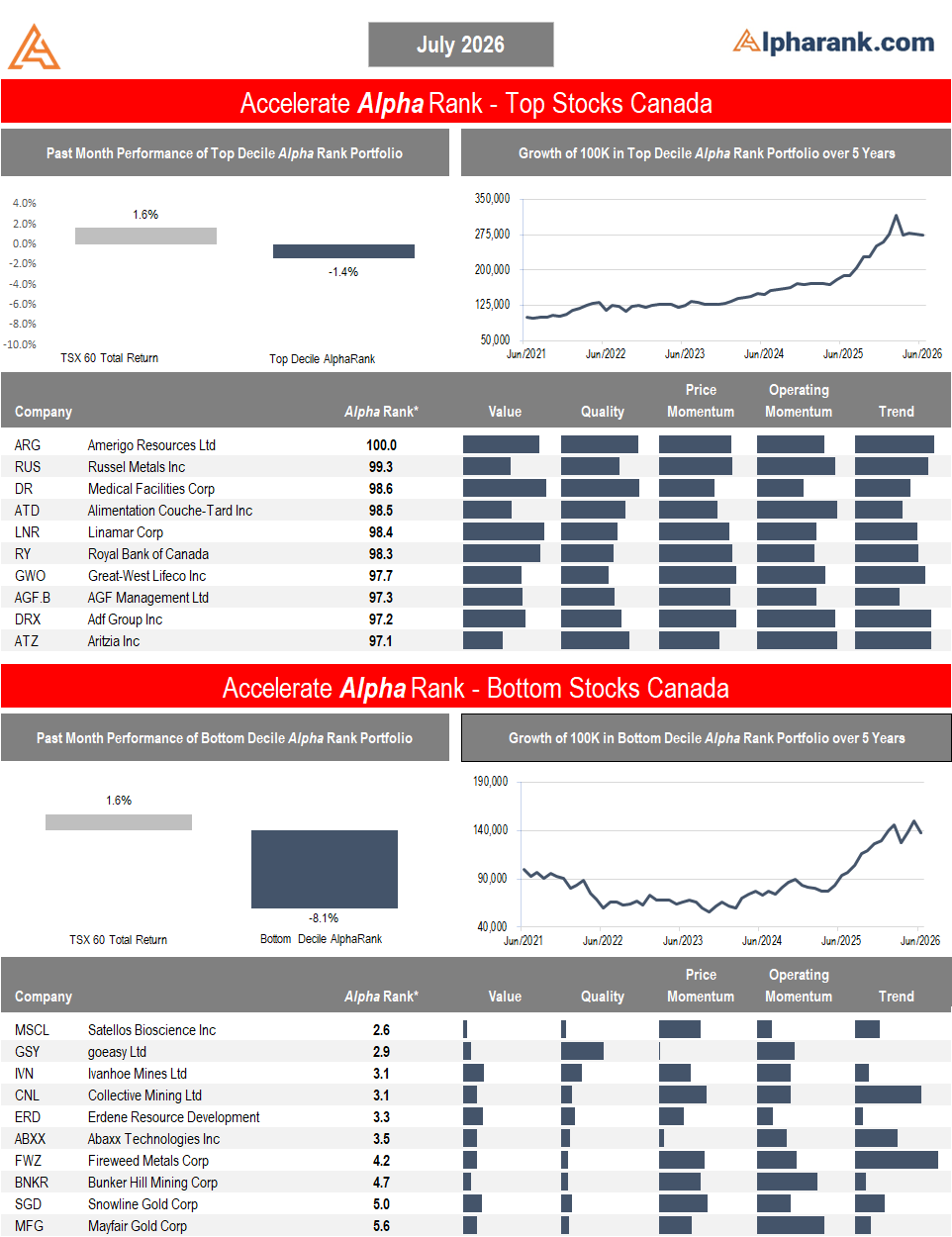
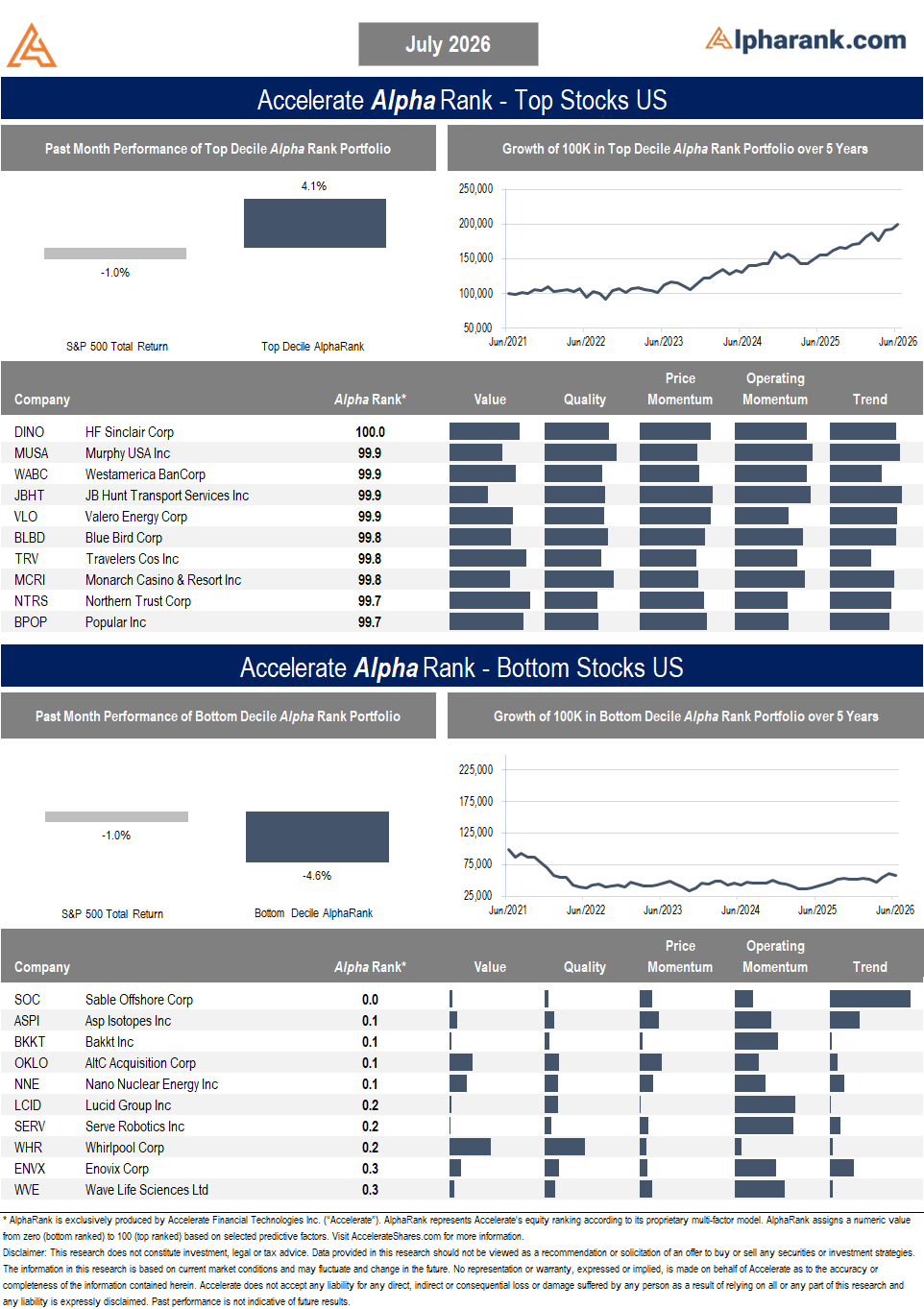
OUTPERFORM: Aritzia Inc (TSE: ATZ) is a Vancouver-based fashion retailer positioned as “everyday luxury”: stylish, relatively premium women’s apparel priced below traditional luxury brands. Its main competitive advantage is that it designs and controls most of its merchandise through proprietary labels. The investment story has increasingly shifted from a successful Canadian retailer to a North American growth brand, with the United States now its largest market. With a return on capital of 35% and revenue growth of 23% to 28%, ATZ is a high-quality growth story. Moreover, it recently beat quarterly expectations materially and raised its 2027 guidance. With positive share price momentum, along with an AlphaRank score of 97.1/100, we expect ATZ shares to continue to outperform. Disclosure: Long ATZ in the Accelerate Absolute Return Fund (TSX: HDGE).
UNDERPERFORM: Lucid Group Inc (NASDAQ: LCID) is a luxury electric-vehicle manufacturer. LCID was highlighted as an underperformer in our inaugural issue of Top Stocks in the fall of 2023 – its stock is down nearly -90% since. Still, we see further underperformance from the stock. The short thesis is that Lucid remains an extremely capital-intensive, subscale automaker whose operating losses, weak unit economics and recurring financing needs may overwhelm its technological strengths. Its ongoing significant operating losses mean it constantly needs new capital to sustain its operations, resulting in additional shareholder dilution, more preferred securities or debt ahead of common equity, or a major operating retrenchment that reduces the company’s growth ambitions. With an AlphaRank score of 0.2/100, we expect LCID shares to continue to underperform.
The AlphaRank Top and Bottom stock portfolios exhibited positive relative performance last month:
- In Canada, the top-ranked AlphaRank portfolio of stocks decreased by -1.4%, underperforming the benchmark’s 1.6% gain, while the bottom-ranked portfolio of Canadian equities fell by -8.1%. The long-short portfolio (top minus bottom-ranked stocks) rose by 6.7%, as the top-ranked stocks outperformed the bottom-ranked securities. Over the past five years, the top decile AlphaRank portfolio has gained 173%, while the bottom-ranked portfolio has risen by 38%.
- In the U.S., the top-decile-ranked equities rose by 4.1%, outperforming the S&P 500’s -1.0% loss. Meanwhile, the bottom-ranked stocks fell by -4.6%, resulting in an 8.7% return for the top decile minus the bottom decile long-short portfolio. Over the past five years, the top-ranked U.S. equities have gained 100%, while the bottom-ranked portfolio has declined by -42%.
AlphaRank Top Stocks represents Accelerate’s predictive equity ranking powered by proven drivers of return. Stocks with the highest AlphaRank are projected to outperform, while stocks with the lowest AlphaRank are anticipated to underperform. AlphaRank assigns a numeric value to each security, ranging from 0 (bottom-ranked) to 100 (top-ranked), based on selected predictive factors. All Canadian and U.S. stocks priced above $1.50 per share and with a market capitalization exceeding $100 million are evaluated. In both the Accelerate Absolute Return Fund (TSX: HDGE) and the Accelerate Canadian Long Short Equity Fund (TSX: ATSX), Accelerate funds may be long many top-ranked stocks and short many bottom-ranked stocks. See AccelerateShares.com for more information.