

October 14, 2026 – The great bond bull market that lasted nearly 40 years, stretching from 1981 to 2020, was one of the longest and most profitable secular bull markets in financial history.
For nearly four decades, U.S. government bond yields trended downward, boosting bond prices and generating exceptional and extraordinary returns for fixed income investors. For investors of that era, declining yields, along with the tailwind to the bond market that they provided, were all that they knew. Fixed income investors had it so good for so long that many investors spent their entire career, from rookie to retirement, in a long-term secular bull market (with some bumps along the way, of course).
That notable period began with the defeat of the inflationary spiral of the 1970s and culminated in the zero interest rate policy established during the COVID pandemic. The 10-year U.S. Treasury yield peaked at 15.8% in September 1981 and bottomed nearly 40 years later at 0.5% in August 2020.
The initial catalyst was Paul Volcker’s campaign to defeat persistent inflation. During the 1970s, the U.S. economy faced relentless inflation caused by oil shocks, loose monetary policy, and rising inflation expectations (sound familiar?).
When Volcker became chair of the Federal Reserve in 1979, he pursued extraordinarily restrictive monetary policy in which he boosted the federal funds rate to 20% by 1981, causing the 10-year yield to jump above 15% and contributing to the severe recession the economy experienced from 1981 to 1982. Nevertheless, by late 1982 and under Volcker’s steady hand, the so-called bond vigilantes began to believe the Fed was succeeding in its battle against inflation, and long-term bond yields subsequently began their nearly 40-year descent.
This secular bull market in bonds reached its apex in 2020, when pandemic-triggered monetary stimulus and recession-driven flight-to-safety demand for Treasury bonds pushed yields to historical lows.
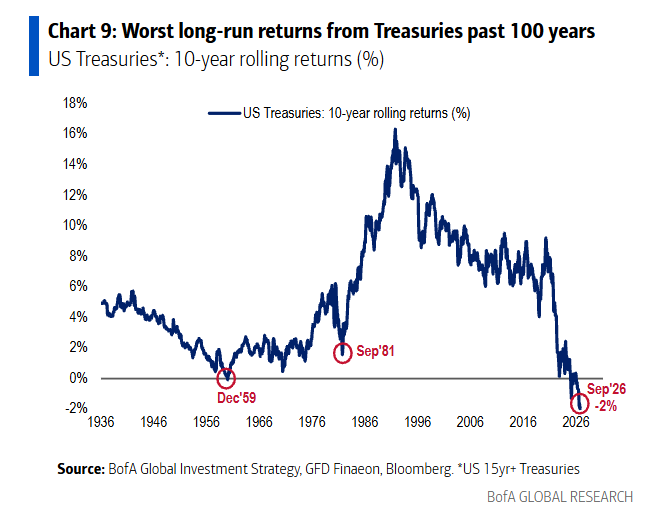
Throughout this four decade period, fixed income investors were able to readily generate annualized returns above 8%. There was a ten year period ending in the mid-1990s in which the U.S. Treasury 10-year rolling return averaged north of 16%.
Alas, the good times couldn’t last forever, and that great, secular 40-year bull run has turned into a bond bear market that began six years ago. Fixed income investors have faced a challenging market amid steadily rising yields, with Treasury bonds delivering their worst ten year return over the past 100 years.
Several factors explain why bond yields are rising.
First, many market participants face an anchoring bias, in which they believe the low yields of recent memory are normal. A recency bias may have led investors to place excessive weight on bond yields of the past 5 to 10 years, which was an era of unusually low levels. That said, the long-term average U.S. Treasury bond yield is 5.8%. Compared to its current level of 5.3%, which, although, is up significantly over the past six years, is still below average. In the context of market history, a 6% 10-year Treasury yield should not be viewed as abnormally high. The current environment’s rising yields could be owed in part to mean reversion.
Second, inflation has consistently been above the Fed’s 2% target for nearly six years. Persistent inflation causes rising inflation expectations, in which investors demand more compensation to offset the erosion of their purchasing power.
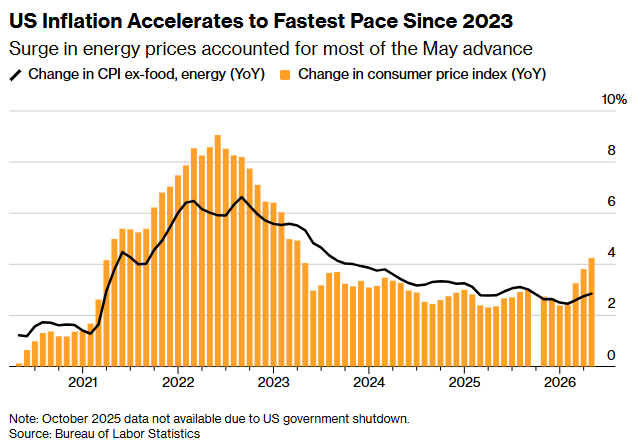
Similar to the inflationary environment of the 1970s, although not nearly as extreme (U.S. inflation peaked at 14.8% in March 1980), above-target rates of inflation can be expected to cause bond yields to rise, pressuring bond prices.
While there are many culprits to blame for the persistent inflation we currently experience, including tariffs, expansion of the money supply, and high government deficits, there is one notably acute factor carrying most of the weight these days.
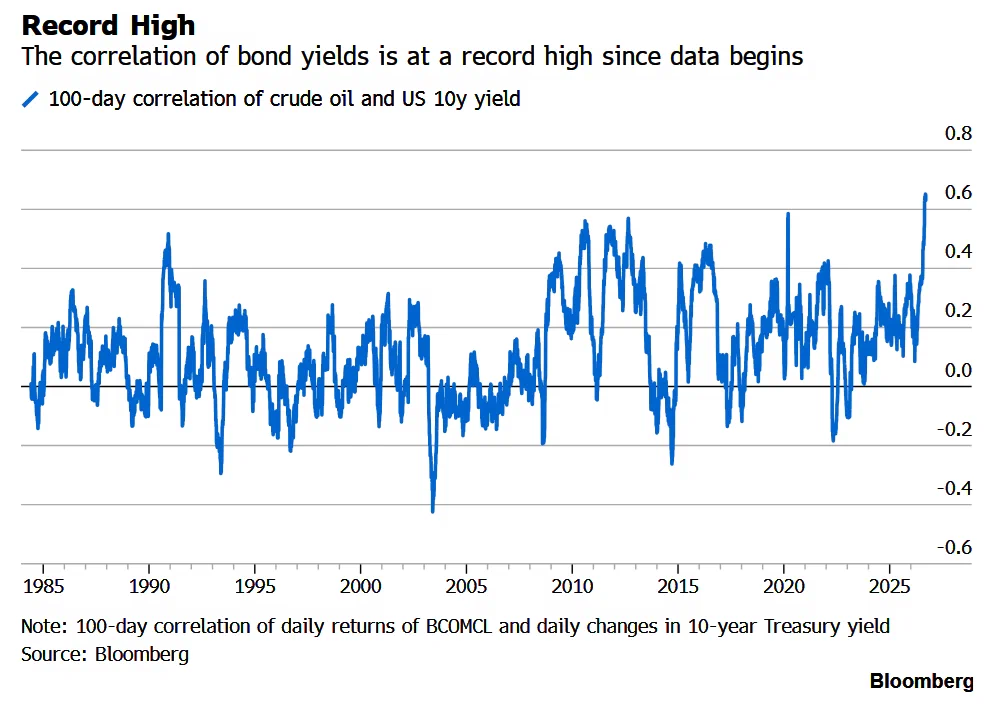
Oil prices have surged off the back of the Iran war, which has disrupted supply. Increased global energy prices have played a key role in pushing inflation higher this year. As a result, the correlation between crude oil prices and the U.S. 10-year Treasury yield has never been higher. Bond yields have been moving in tight lockstep with oil prices. Oil up, bonds down.
Nevertheless, while credit investors still have lingering concerns regarding the SaaSpocalypse, equity investors seem to have determined that AI will not significantly threaten the favourable underlying fundamentals of software businesses. The market is still sorting out who is right.
Lastly, one can point to simple supply and demand factors – it’s economics 101. For a constant level of demand, as the supply of bonds rises, the price for bonds must fall (and yields must increase).
Large fiscal deficits are financed by enormous government borrowing. The U.S. deficit is expected to reach $1.9 trillion this year, representing 5.8% of GDP, which is funded by new debt issuance.
As a result of consistent and rising government budget deficits, the supply of national debt has been growing significantly, not only on an absolute basis but also as a percentage of economic output.
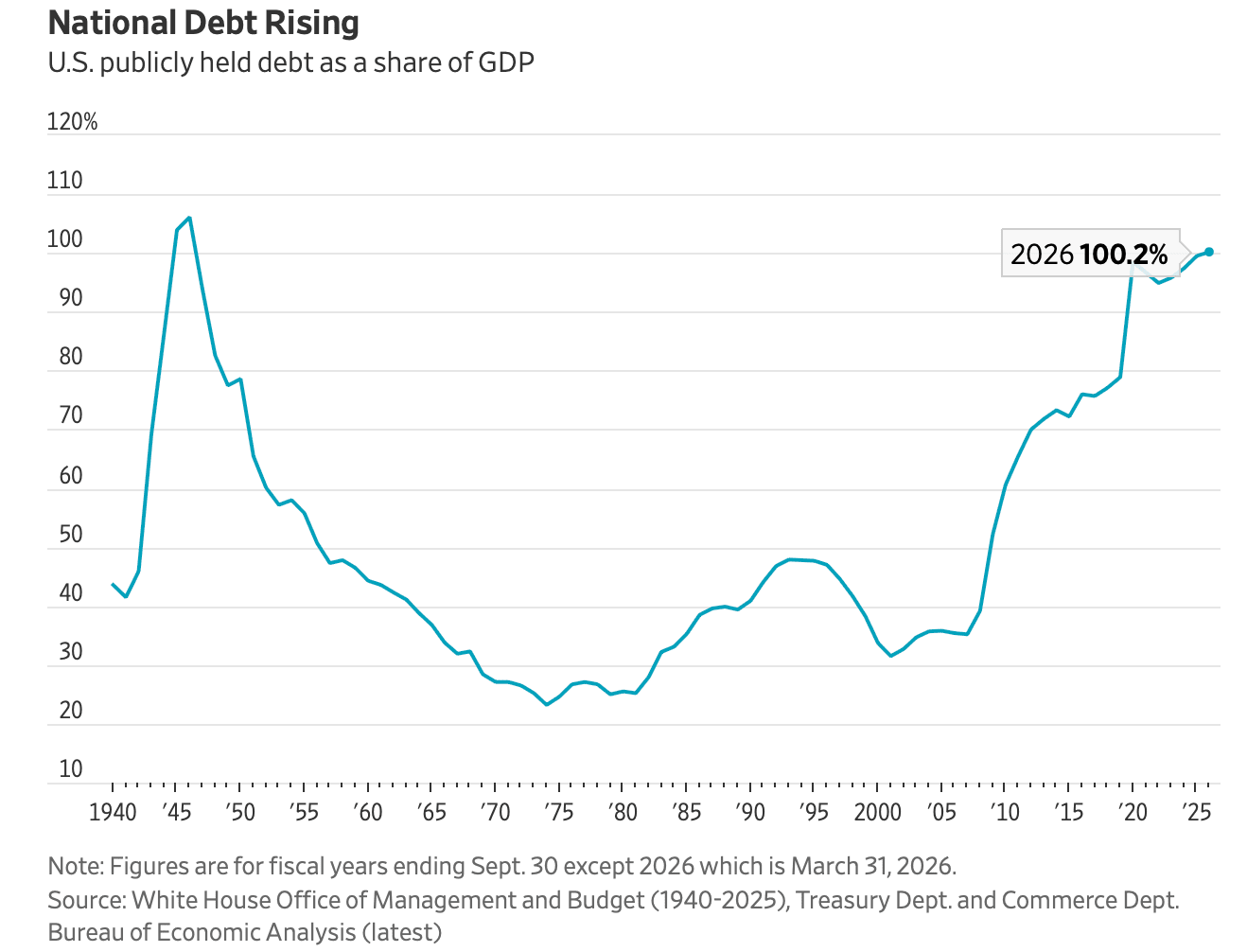
When the government consistently issues more bonds to fund its deficit, investors must absorb that supply. All else equal, the price required to clear the market falls, and therefore yields must rise.
That said, all else is not equal. The U.S. government now faces rising competition for bond investor attention from corporate issuers. Specifically, large corporations building out artificial intelligence infrastructure, including the hyperscalers and the chip companies, are expected to issue more than $200 billion of debt this year to fund their growth. Compared with the U.S. government’s expected approximately $2 trillion in debt issuance this year, large technology companies are becoming a significant addition to the supply of paper potentially overwhelming fixed income investors. Even Fed Chair Kevin Warsh recently noted that the competition for capital from corporations has been pressuring bond prices: “hyperscalers are out in the market raising funding”.
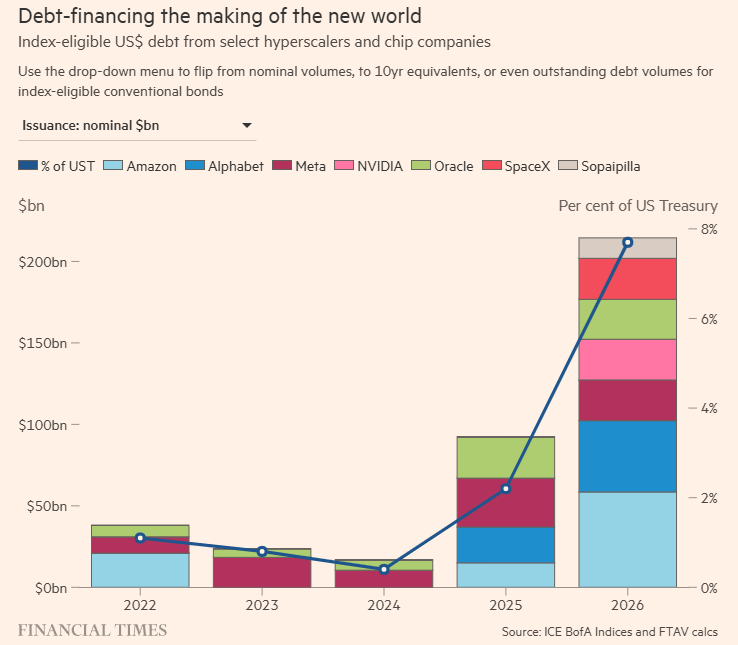
While the era of unusually low interest rates and seemingly insatiable demand for bonds appears to be firmly behind us, fixed income investors find themselves stuck in what could be a long-term secular bear market. While the downturn has lasted a painful six years, it must be viewed in context compared with the previous exceptional secular bull market that lasted forty years.
Several factors continue to contribute to the bear market in bonds. While bond yields still fall below long term averages, persistent inflation, exacerbated by rising oil prices, continues to exert upward pressure on yields. Nevertheless, the more consequential force may be the relentless expansion of the supply of bonds, both from the U.S. government and from large technology companies. With fiscal deficits showing little sign of abating, and the AI infrastructure boom continuing to consume seemingly endless amounts of capital, investors are being asked to absorb an ever-growing mountain of bonds.
And it is not just an American phenomenon. While the U.S. Treasury bond serves as a key benchmark, government bond yields have faced a relentless rise globally, aggravated by the same issues including high and rising inflation, surging oil prices, persistent deficits, and an overwhelming amount of issuance. Sovereign borrowing costs have reached multi-decade highs across several developed economies, including Japan, Germany, and the U.K.
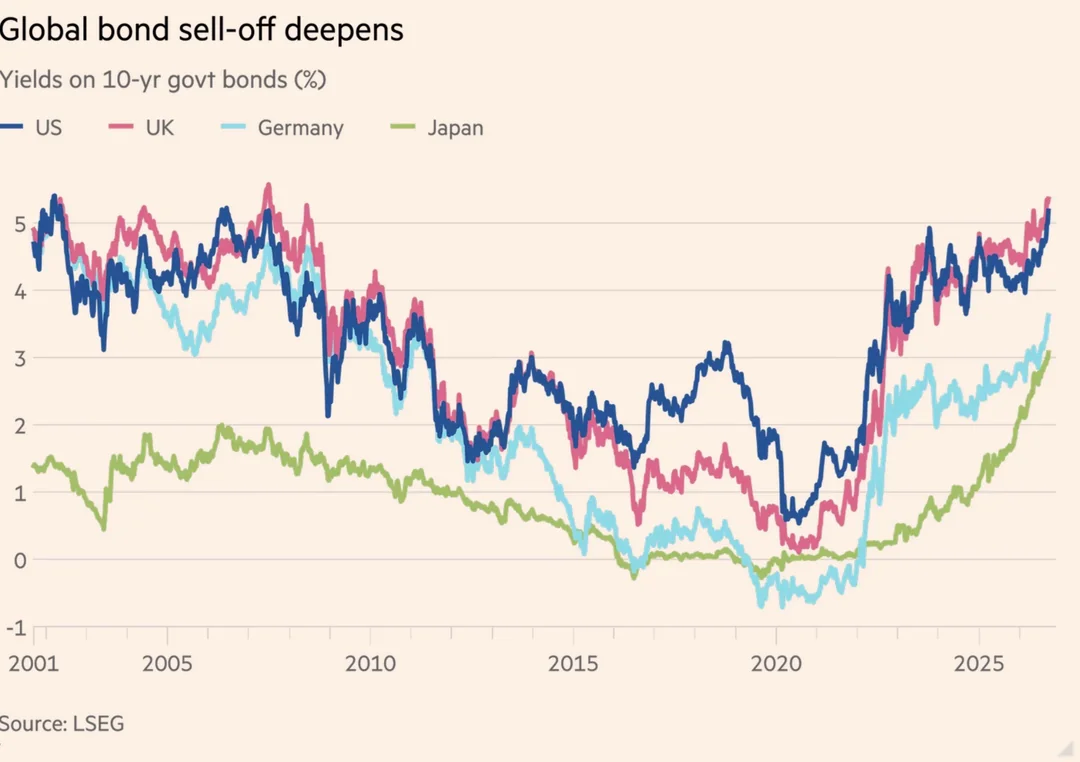
Unlike the great secular bond bull market that began in the early 1980s, today’s fixed income investors face a decidedly less favourable supply-demand dynamic. Ultimately, we can expect the foundational laws of economics to remain undefeated: too many bonds chasing too few buyers means lower bond prices and higher yields.
Accelerate manages five alternative investment solutions, each with a specific mandate:
- Accelerate Arbitrage Fund (ETF Ticker: ARB, Series F: AFT201, Advisor Series: AFT200) – Merger Arbitrage
- Accelerate Absolute Return Fund (ETF Ticker: HDGE, Series F: AFT101, Advisor Series: AFT100) – Absolute Return
- Accelerate OneChoice Alternative Multi-Asset Fund (ETF Ticker: ONEC, Series F: AFT401, Advisor Series: AFT400) – Multi-Asset
- Accelerate Canadian Long Short Equity Fund (ETF Ticker: ATSX, Series F: AFT301, Advisor Series: AFT300) – Long Short Equity
- Accelerate Diversified Credit Income Fund (ETF Ticker: INCM / INCM.B / INCM.U, Series F: AFT501 / AFT501H, Advisor Series: AFT500 / AFT500H) – Private Credit
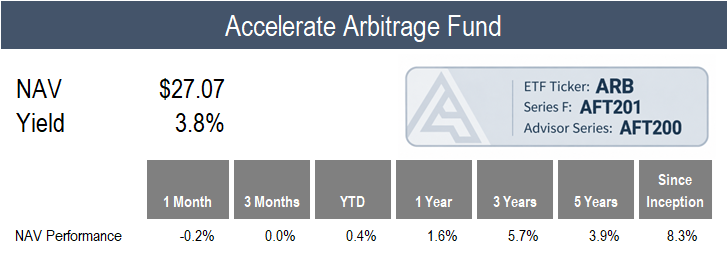
ARB declined by -0.2% in September, compared with the benchmark S&P Merger Arbitrage Index’s -1.5% loss.
The Fund added two new merger arbitrage investments (one American, one Canadian), and allocated to four SPAC IPOs. During the month, the Fund exited several completed merger investments, including ARC Resources / Shell, Crinetics Pharmaceuticals / Vertex Pharmaceuticals, Apogee Therapeutics / AbbVie, and DigitalBridge / SoftBank.
Currently, ARB is 172.5% long and -0.6% short (173.1% gross exposure), with 84% allocated to SPAC arbitrage and 16% to merger arbitrage (with 4% in LBOs and 12% in strategic M&A).

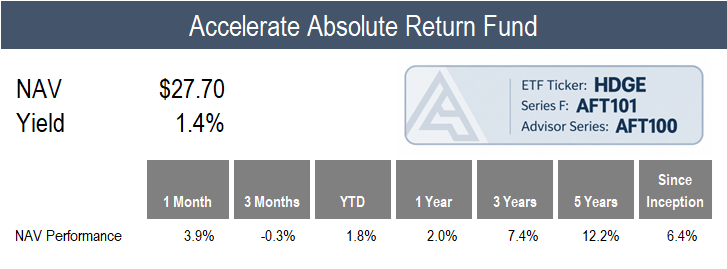
For the month of September, HDGE returned 3.9%, primarily driven by its short portfolio.
North American multifactor long short investing paid dividends last month, as all major long-short factor portfolios posted positive returns. The result was driven primarily by the trend, value, and price momentum factors, where long equity positions significantly outperformed shorts on average.
Moreover, the environment was favourable to HDGE’s absolute return strategy. Notably, the GS Most Shorted basket plunged by -5.8% while the GS long short hedge fund proxy gained 5.6%.
Top Fund contributors include short positions in Terrestrial Energy, NovaGold Resources, and Portillo’s. Top Fund detractors include long positions in Expedia, TechnipFMC, and Tidewater.
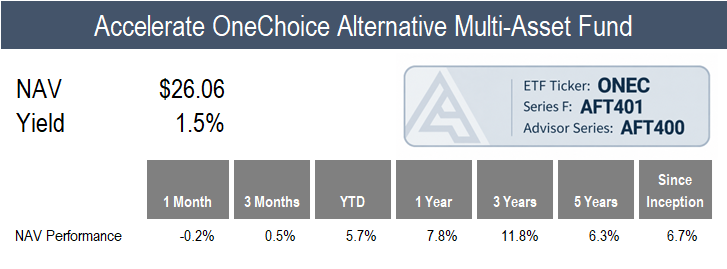
ONEC declined by -0.2% in September – a month characterized by variable alternative asset class performance.
ONEC’s hedge fund allocations generally performed well for the month. The managed futures portfolio led the pack with a 4.0% return, followed by the Fund’s absolute return and long short equity allocations, which gained 3.9% and 2.4%, respectively. The merger arbitrage and leverage loan portfolios were approximately flat.
On the negative side of the ledger, ONEC’s gold allocation bore the brunt of the damage with an -8.5% loss, while risk parity declined by -5.3%. In addition, the real estate, infrastructure, private credit, and commodity allocations fell between -1.5% and -3.8%.
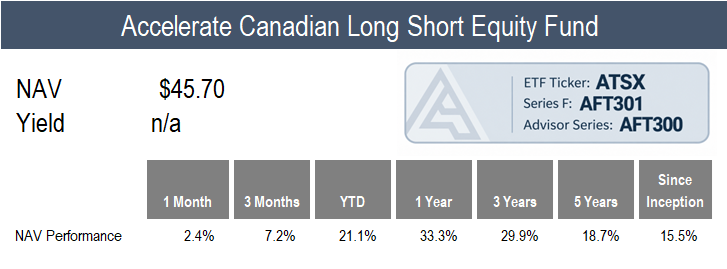
ATSX gained 2.4% for the month compared to the benchmark S&P/TSX 60’s -2.5% loss. The Fund’s outperformance was buoyed by its multifactor short portfolio.
All Canadian multifactor portfolios generated significant positive alpha in September. The long-short trend portfolio gained 17.3% while the market neutral value portfolio rose 9.7%. The quality, price momentum, and operating momentum factors gained between 5.6% and 7.8%.
Top Fund contributors include a long position in Russel Metals as well as short positions in NovaGold Resources and Denison Mines. Top Fund detractors include long positions in Ovintiv, Aritzia, and IAMGOLD.
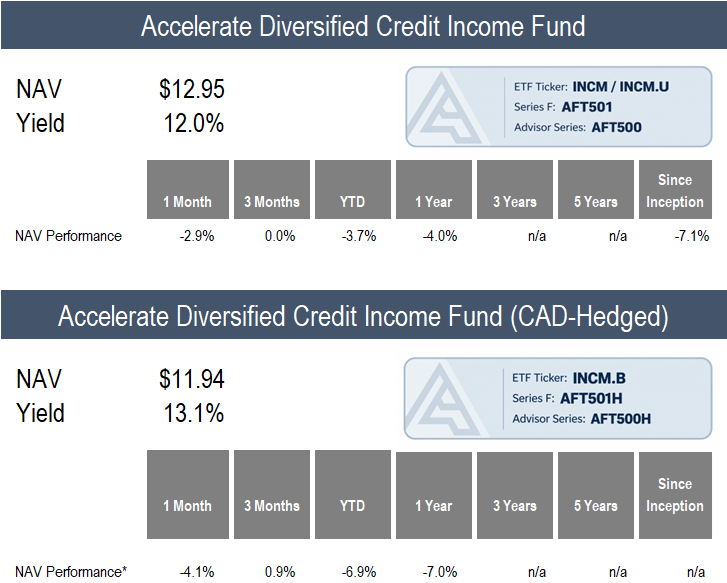
INCM fell by -2.9% (-4.1% in CAD-hedged terms) in September, primarily due to NAV discounts widening. Overall, market weakness overwhelmed the BDC sector after a positive post-second quarter bump. The Fund’s average NAV discount widened from -18.6% to -26.8%, the widest level of the current down cycle. Third quarter BDC reporting starts on October 27th and continues throughout November, which will provide an updated snapshot of the state of the private credit market.
Currently, INCM is allocated to 20 private credit portfolios (through listed BDCs), totalling more than 5,000 loans and investments, of which 84.8% are senior secured and 90.8% are floating rate. The current yield on the INCM portfolio is 12.9%, and it trades at a -26.8% discount to its net asset value. INCM’s exposure to software loans is 16.9% of its portfolio.
Have questions about Accelerate’s investment strategies? Click below to book a call with me:

-Julian
Disclaimer: This distribution does not constitute investment, legal or tax advice. Data provided in this distribution should not be viewed as a recommendation or solicitation of an offer to buy or sell any securities or investment strategies. Please read the relevant prospectus before investing. For a summary of the risks of an investment in the Accelerate ETFs, please see the specific risks set out in the prospectus. ETFs are not guaranteed and the information in this distribution is based on current market conditions and may fluctuate and change in the future. Past performance is not indicative of future results. Decisions regarding tax, investments, and all other financial matters should be made solely with the guidance of a qualified professional. Visit www.AccelerateShares.com for more information.