August 23, 2026 – Wall Street is full of figures of speech — the prime example being Wall Street itself, a metonym for the broader U.S. stock market, even though most securities trading no longer takes place there.
Bull market, smart money, dry powder, falling knife, dead-cat bounce, flight to safety, blood in the streets — the capital markets run on colourful language.
One that sends chills through systematic investors is quant quake, referring to a violent market dislocation (i.e., losses) in quantitative investment strategies. The prime example of a quant quake occurred in August 2007, when a number of quantitative market-neutral and statistical-arbitrage hedge funds suffered unusually large losses at the same time, even though the broad stock market was relatively calm. This dynamic was driven primarily by crowding and deleveraging (also known as degrossing). Many quant funds employ similar strategies and hold similar factor exposures despite using different proprietary models. One example would be to go long stocks with positive share price momentum and short those with negative momentum (the long-short momentum factor). When one or more players are forced to derisk and liquidate positions to degross their portfolios, those trades cause painful moves against competitors holding similar exposures, exacerbating the crisis.
This dynamic creates a negative feedback loop in which a forced seller causes crowded positions to move adversely and other quant funds suffer further losses. Those losses trigger risk limits, forcing additional selling, pushing prices further and amplifying the drawdown.
What made the episode memorable was not only the speed of the quant quake, which lasted just a handful of days in early August 2007, but also the swiftness of the reversal, as stressed positions quickly bounced back. Ultimately, the quant quake played out over four trading sessions and reversed dramatically on the fifth.
Since then, smaller, short-lived dislocations in quantitative investment strategies have come to be known as quant tremors.
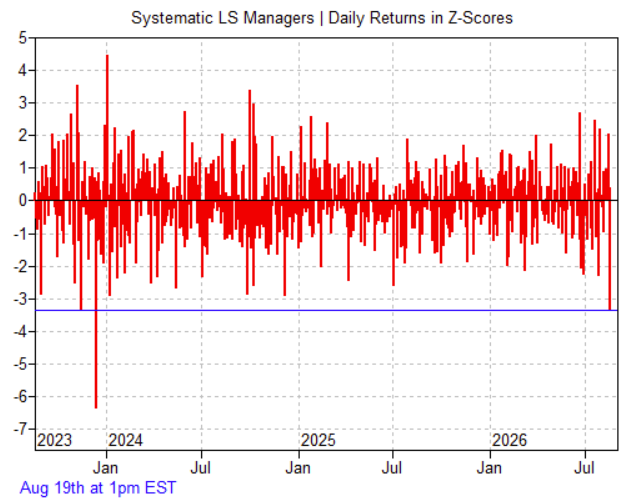
Last Wednesday, a quant tremor transpired as a factor unwind and forced degrossing swept through the market. The average systematic long-short equity fund declined by -1.4% on the day, a move of more than three standard deviations and its worst daily loss in more than two years. This painful move occurred despite the broad stock market being roughly flat on the day.
Source: Zero Hedge
A couple of catalysts spurred the painful move for systematic investors.
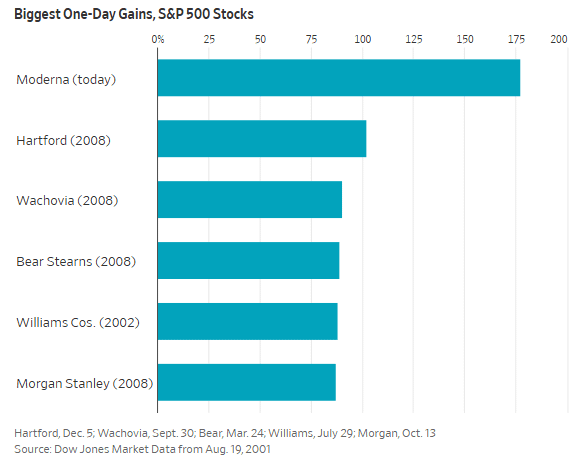
First, biotech company Moderna announced successful trial results for its mRNA cancer vaccine. The positive news caused Moderna’s stock to skyrocket by more than 175% on Wednesday, the largest one-day gain for an S&P 500 stock in at least 25 years.
The success of Moderna’s cancer vaccine is exceptionally positive news for humankind. From a stock market perspective, however, the stock’s surge caused reverberations across long-short portfolios. Moderna’s stock is large and liquid, and it was heavily shorted. The stock’s record-breaking one-day surge triggered risk controls in short portfolios, leading to a broad-based unwind and degrossing of systematic strategies. That day, a basket of the most shorted stocks surged while a portfolio of hedge fund favourites tanked.
Second, and to a lesser extent, the U.S. Treasury intervened in the long-term Treasury market with the goal of lowering yields after a sharp bond market selloff pushed the 30-year yield north of 5.3%, its highest level in nearly 20 years. On Wednesday, the U.S. Treasury unexpectedly announced it would at least double the size of its long-duration bond buybacks from $2 billion to $4 billion, providing another abrupt shock to the market. Ironically, within days, the bond market intervention initiative proved unsuccessful, as bond yields finished higher on the week. Meanwhile, the dollar dropped by -0.56% and gold jumped 5.2% — likely the opposite of the intended result.
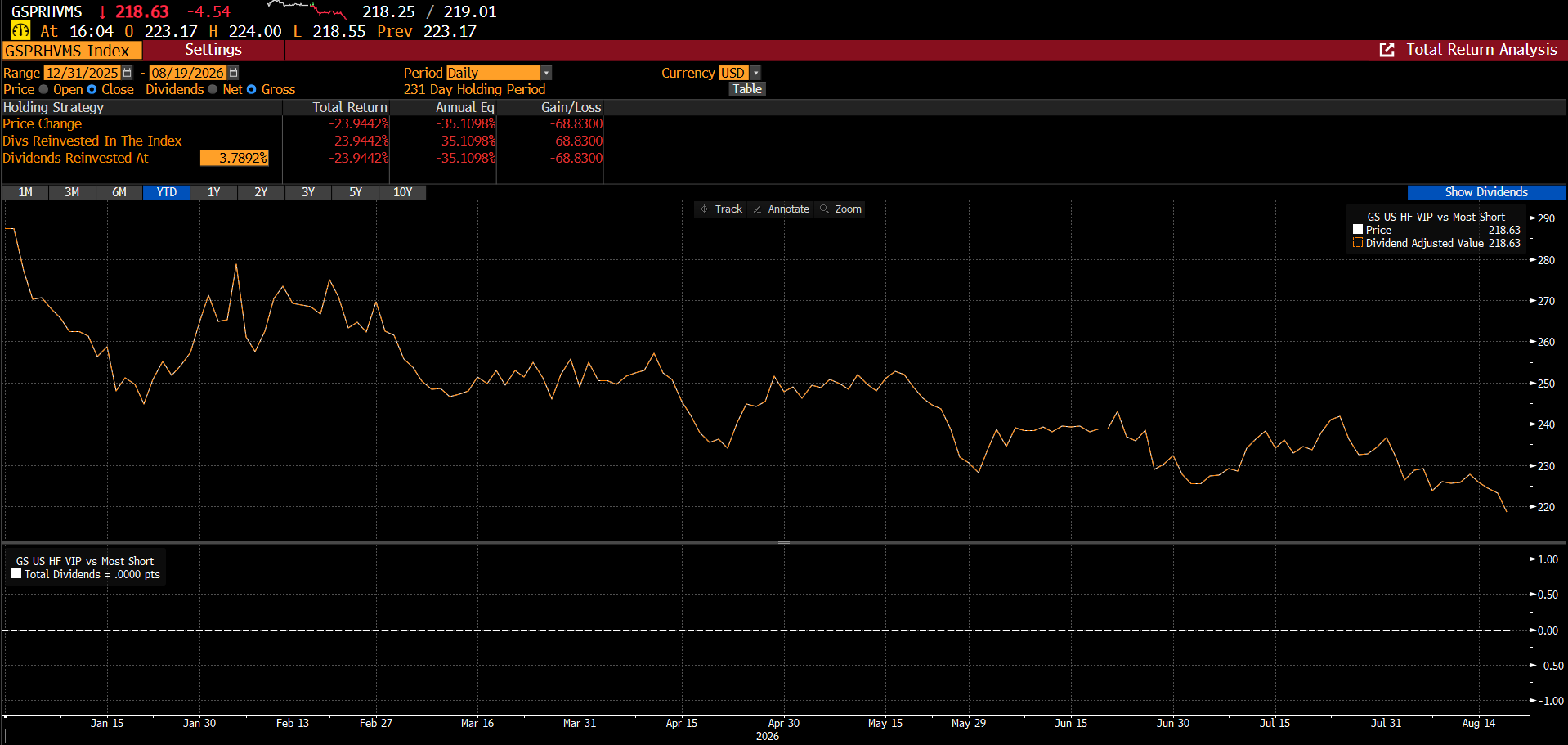
Ultimately, these events led to another tough day in a challenging year for long-short and market-neutral equity investing, particularly on the short side. The long short equity proxy (GS VIP longs minus the GS Most Shorted basket) hit a new low for the year and is down -24% year-to-date. It has been pretty much a straight line down this year, as the junkiest stocks surge and the highest quality stocks lag.
 Source: Bloomberg
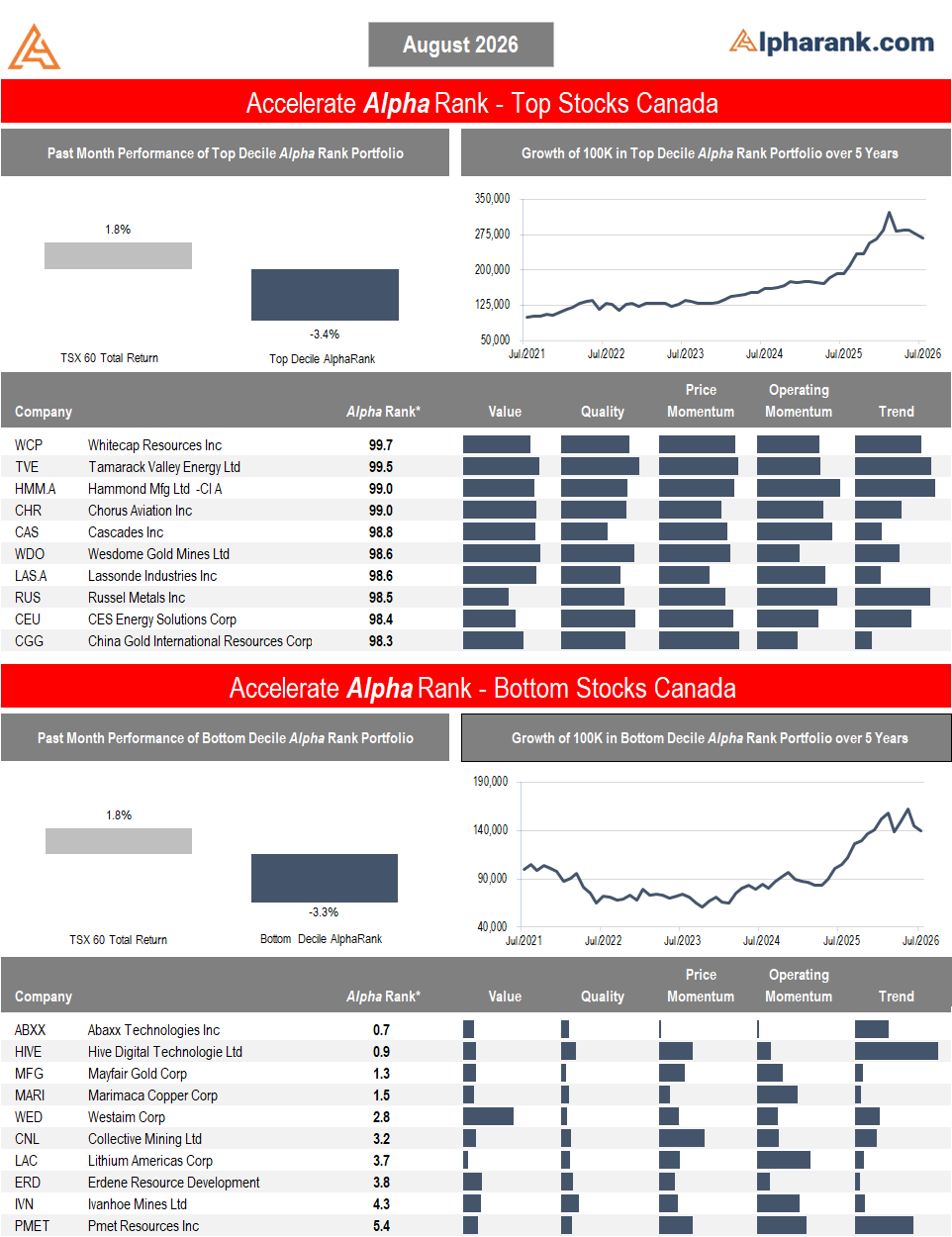
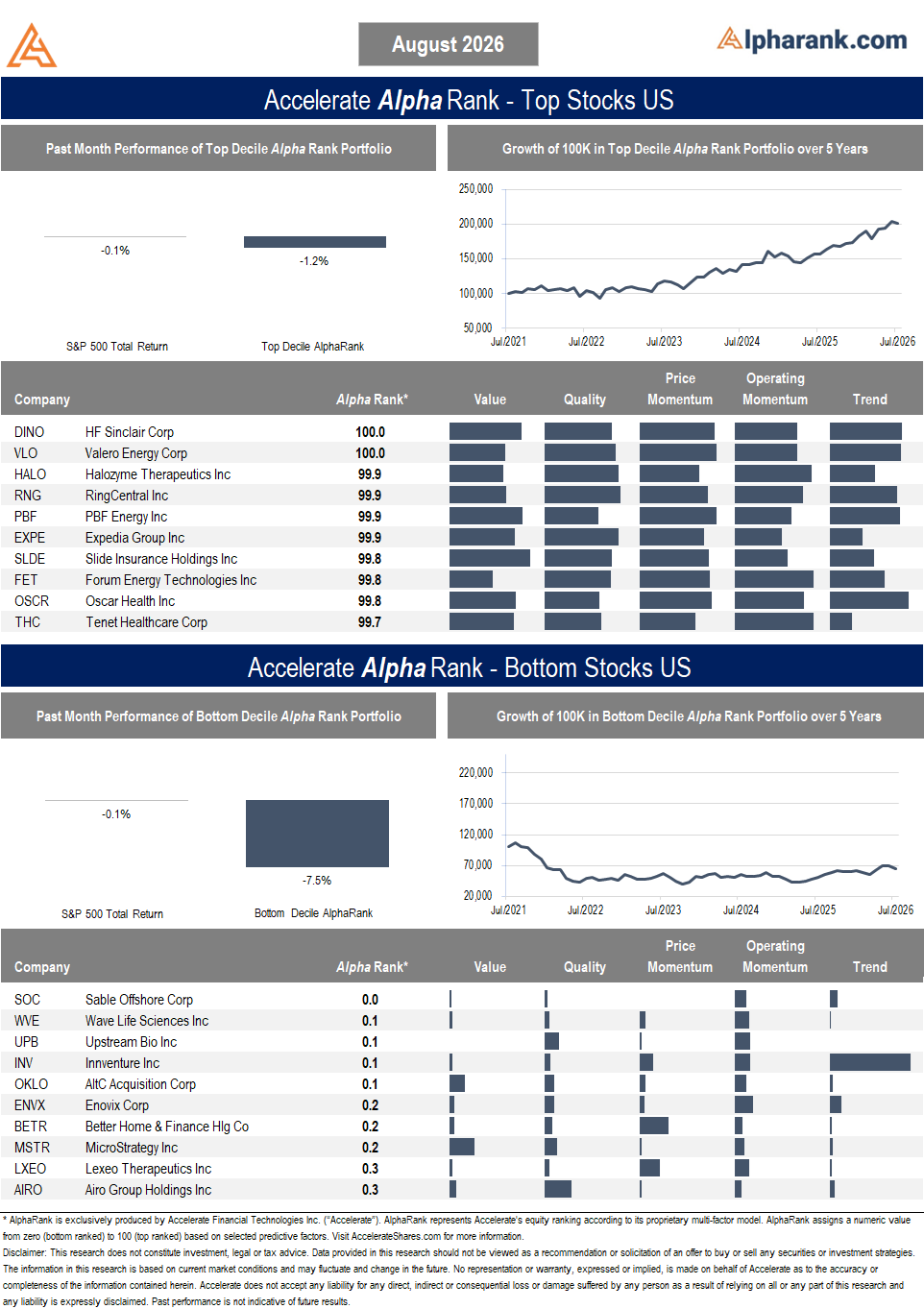
Nevertheless, as historical quant quakes and tremors have shown, these episodes tend to be ephemeral, and the strategies tend to bounce back. With that, we highlight one top-decile stock forecast to outperform and one bottom-decile stock predicted to underperform based on Accelerate’s multi-factor composite model in this month’s AlphaRank Top Stocks.
OUTPERFORM: Valero Energy Corp (NYSE: VLO) is one of the largest independent refiners in the world, operating 14 refineries with roughly 3.0 million barrels/day of throughput capacity, plus sizable renewable diesel and ethanol businesses. VLO trades at a below market multiple of 7.4x EBITDA and is rapidly buying back its shares, repurchasing 7.3% over the past year and driving earnings per share growth. Moreover, VLO’s 34.4% return on capital and 9.5% free cash flow yield further burnish the bull case for the stock. With positive share price momentum, along with an AlphaRank score of 100/100, we expect VLO shares to continue to outperform. Disclosure: Long VLO in the Accelerate Absolute Return Fund (TSX: HDGE).
UNDERPERFORM: Telus Corporation (TSX: T) is a highly leveraged, capital-intensive, ex-growth telecom that historically commanded a premium because of its dividend-growth reputation. After slashing its dividend and turning over senior leadership, its story is now broken, and it is now a turnaround. It recently missed street expectations and reduced its guidance, which further pressured the shares. T’s valuation remains too high for value investors to step in, leaving the stock in purgatory. With negative share price momentum and an AlphaRank score of 13.4/100, we expect T shares to continue to underperform. Disclosure: Short T in the Accelerate Canadian Long Short Equity Fund (TSX: ATSX).
The AlphaRank Top and Bottom stock portfolios exhibited mixed relative performance last month:
- In Canada, the top-ranked AlphaRank portfolio of stocks decreased by -3.4%, underperforming the benchmark’s 1.8% gain, while the bottom-ranked portfolio of Canadian equities fell by -3.3%. The long-short portfolio (top minus bottom-ranked stocks) declined by -0.1%, as the top-ranked stocks outperformed the bottom-ranked securities. Over the past five years, the top decile AlphaRank portfolio has gained 168%, while the bottom-ranked portfolio has risen by 40%.
- In the U.S., the top-decile-ranked equities fell by -1.2%, underperforming the S&P 500’s -0.1% loss. Meanwhile, the bottom-ranked stocks fell by -7.5%, resulting in a 6.3% return for the top decile minus the bottom decile long-short portfolio. Over the past five years, the top-ranked U.S. equities have gained 102%, while the bottom-ranked portfolio has declined by -36%.
AlphaRank Top Stocks represents Accelerate’s predictive equity ranking powered by proven drivers of return. Stocks with the highest AlphaRank are projected to outperform, while stocks with the lowest AlphaRank are anticipated to underperform. AlphaRank assigns a numeric value to each security, ranging from 0 (bottom-ranked) to 100 (top-ranked), based on selected predictive factors. All Canadian and U.S. stocks priced above $1.50 per share and with a market capitalization exceeding $100 million are evaluated. In both the Accelerate Absolute Return Fund (TSX: HDGE) and the Accelerate Canadian Long Short Equity Fund (TSX: ATSX), Accelerate funds may be long many top-ranked stocks and short many bottom-ranked stocks. See AccelerateShares.com for more information.