

April 27, 2026 – One of the biggest challenges that an investor may face is buying a stock when it is trading at its 52-week high. There are several reasons why buying at this level can be psychologically difficult:
- Investors anchor to lower past prices. If a stock was $50 and now trades at $100, they feel like they “missed it,” even though the business or market perception may have improved. Some often wait for a “better entry.” The problem is that the pullback may never come, or it may come only after the stock is much higher.
- Many investors are trained to look for bargains, discounts, and mean reversion. Buying strength feels like the opposite of “buy low, sell high”.
- Buying something making new highs feels less sophisticated than buying something cheap and unloved. Investors often prefer the story of being contrarian, even when the data favours momentum.
The hardest stocks to buy are often the ones the market is telling you are working.
Nevertheless, academic research supports buying stocks at their highs, as this strategy has historically outperformed.
A foundational paper was published in The Journal of Finance in 2004 – The 52-Week High and Momentum Investing by George and Hwang. The paper argues that a stock’s closeness to its 52-week high explains a large portion of traditional momentum profits. The authors state, “Nearness to the 52-week high dominates and improves upon the forecasting power of past returns (both individual and industry returns) for future returns. Future returns forecast using the 52-week high do not reverse in the long run.” Stocks closest to their 52-week highs tend to keep outperforming, while stocks farthest from their 52-week highs tend to underperform. George and Hwang note that the 52-week-high strategy earns about 0.65% per month, versus 0.38% for traditional stock momentum and 0.25% for industry momentum. Excluding January, the gap is even larger: 1.06% per month for the 52-week-high strategy versus 0.46% and 0.22% for the other two.
The behavioural explanation is that investors anchor on the 52-week high. When good news arrives, they may underreact if the stock is already near its prior high, viewing it as expensive, which allows momentum to continue as prices adjust gradually.
Accelerate updated this thesis and tested it out of sample, utilizing North American stock data from 2006 to present and rebalancing the factor portfolios monthly. Over the past twenty years, the top quintile of stocks closest to their 52-week highs has returned 10.0% annualized. In contrast, the bottom quintile, or those trading furthest from their 52-week high, returned just 1.9% per annum.
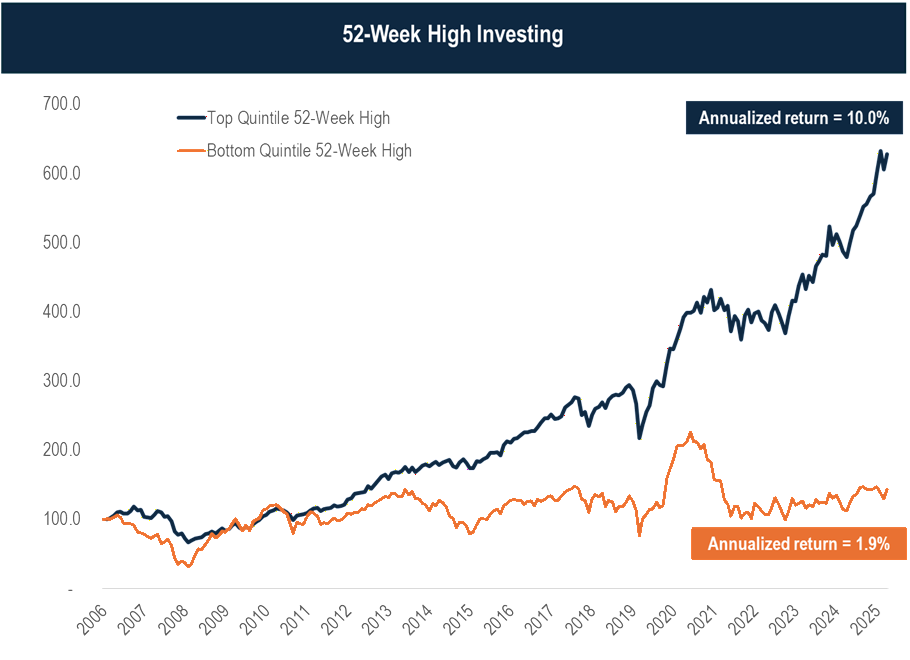
Source: Accelerate
Stocks near their 52-week highs have historically tended to outperform those far from their highs, so investors need not fear the new high when they buy.
Accordingly, from a practitioner’s standpoint, the data show that 52-week high investing, particularly from a long-short perspective, can be an attractive investment strategy. Given the effectiveness of 52-week high investing, which tends to improve when combined with other robust and uncorrelated systematic factors into a multi-factor approach, investors may benefit from utilizing factor rankings when selecting securities to go long or short. To help facilitate idea generation, we highlight one top-decile stock that is forecasted to outperform and one bottom-decile stock that is predicted to underperform in this month’s AlphaRank Top Stocks.
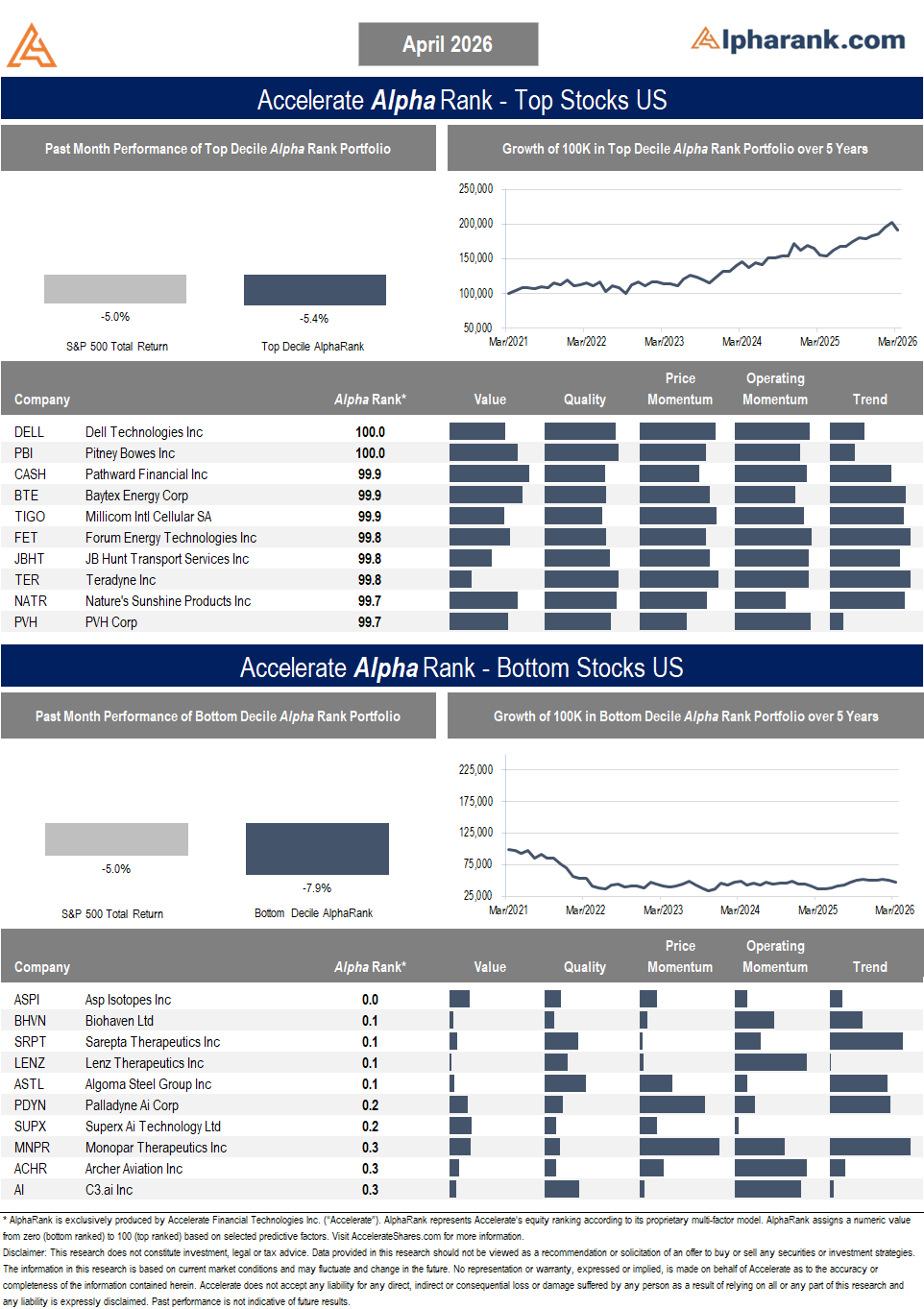
OUTPERFORM: Dell Technologies Inc. (NYSE: DELL) is no longer just a mature PC and enterprise hardware company. The bull case is that Dell has become one of the key “picks and shovels” vendors for the AI infrastructure boom, supplying servers, storage, networking, services, and financing to enterprises and cloud/AI infrastructure customers. The core business has two main segments: Infrastructure Solutions Group, which includes servers, storage, and networking, and Client Solutions Group, which includes commercial and consumer PCs. The AI story is concentrated in ISG, where demand for GPU-heavy AI servers has materially changed Dell’s growth profile. DELL trades at a below-market multiple of 11.1x EBITDA while generating an attractive 57.4% return on capital. The company solidly beat estimates last quarter and has been returning capital to shareholders, reducing its shares outstanding by -6.3% over the past year. With positive share price momentum, along with an AlphaRank score of 100/100, we expect DELL shares to continue to outperform. Disclosure: Long DELL in the Accelerate Absolute Return Fund (TSX: HDGE).
UNDERPERFORM: Algoma Steel Group Inc. (NasdaqGM: ASTL) is a Canadian steel producer that makes hot and cold rolled sheet and plate products for sectors such as automotive, construction, energy, defence, infrastructure, and manufacturing. Algoma is a highly cyclical, capital-intensive steel company facing a difficult transition while earnings are under pressure. ASTL faces a myriad of negative characteristics, including negative EBITDA guidance, lower shipments, tariff costs, rising debt levels, and commodity-cycle risk. With an AlphaRank score of 0.1/100, we expect ACHR shares to continue to underperform.
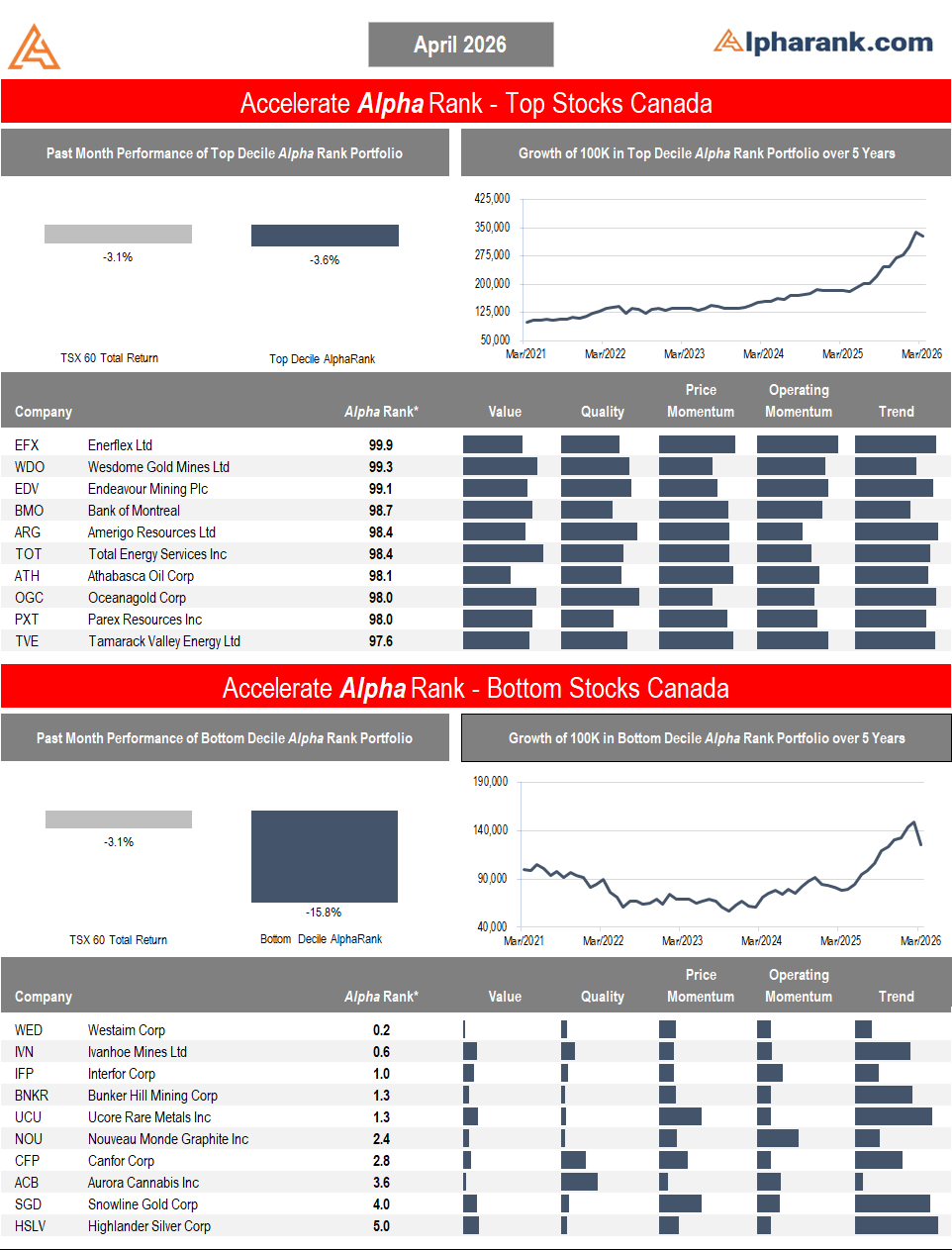
The AlphaRank Top and Bottom stock portfolios exhibited mixed relative performance last month:
- In Canada, the top-ranked AlphaRank portfolio of stocks declined by -3.6%, underperforming the benchmark’s -3.1% fall, while the bottom-ranked portfolio of Canadian equities slumped by -15.8%. The long-short portfolio (top minus bottom-ranked stocks) increased by 12.2%, as the top-ranked stocks outperformed the bottom-ranked securities. Over the past five years, the top decile AlphaRank portfolio has gained more than 220%, while the bottom-ranked portfolio has risen by 25%.
- In the U.S., the top-decile-ranked equities fell by -5.4%, underperforming the S&P 500’s -5.0% return. Meanwhile, the bottom-ranked stocks decreased by -7.9%, resulting in a 2.5% return for the top decile minus the bottom decile long-short portfolio. Over the past five years, the top-ranked U.S. equities have gained nearly 100%, while the bottom-ranked portfolio has declined by approximately -50%.
AlphaRank Top Stocks represents Accelerate’s predictive equity ranking powered by proven drivers of return. Stocks with the highest AlphaRank are projected to outperform, while stocks with the lowest AlphaRank are anticipated to underperform. AlphaRank assigns a numeric value to each security, ranging from 0 (bottom-ranked) to 100 (top-ranked), based on selected predictive factors. All Canadian and U.S. stocks priced above $1.50 per share and with a market capitalization exceeding $100 million are evaluated. In both the Accelerate Absolute Return Fund (TSX: HDGE) and the Accelerate Canadian Long Short Equity Fund (TSX: ATSX), Accelerate funds may be long many top-ranked stocks and short many bottom-ranked stocks. See AccelerateShares.com for more information.